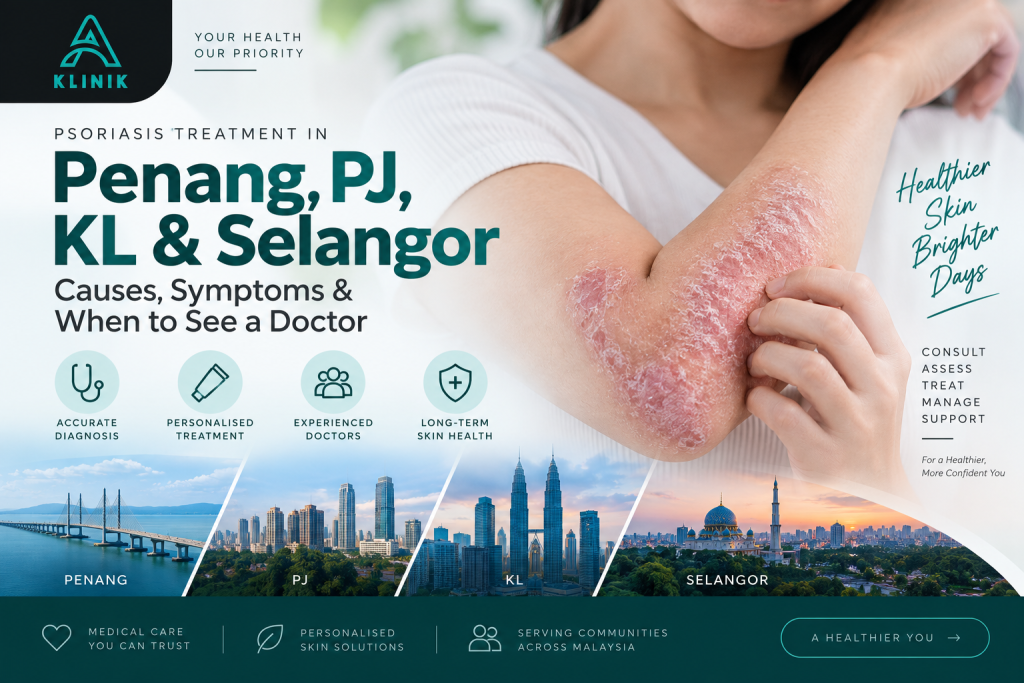


Psoriasis Treatment in Penang, PJ, KL & Selangor: Causes, Symptoms & When to See a Doctor
Psoriasis is more than just dry or flaky skin. It is a chronic inflammatory, immune-mediated skin condition that can have a significant impact on physical comfort, daily activities, sleep and emotional wellbeing.
For many patients, psoriasis causes persistent red or discoloured patches, thickened skin, scaling, itching and recurring flare-ups.
Because psoriasis can resemble other skin conditions such as eczema, fungal infections or allergic rashes, some people may delay seeking medical attention or attempt to manage their symptoms using over-the-counter creams that do not address the underlying condition.
Without an accurate diagnosis, symptoms may remain uncontrolled or inappropriate treatment may be used.
Although psoriasis is a long-term condition, modern psoriasis treatment focuses on reducing inflammation, controlling flare-ups, relieving symptoms and improving quality of life.
With appropriate medical care, many patients can manage their psoriasis effectively and maintain better long-term control.
For patients looking for psoriasis treatment in Penang, PJ, KL & Selangor, understanding the condition and obtaining an appropriate medical assessment are important first steps.
In this guide, we’ll explain what psoriasis is, what may contribute to it, different types of psoriasis, common symptoms, available treatment approaches and when you should consult a doctor.
What Is Psoriasis?
Psoriasis is a chronic immune-mediated inflammatory skin condition in which immune activity contributes to accelerated skin-cell turnover and inflammation.
Instead of shedding normally, skin cells can accumulate on the surface, contributing to raised, inflamed and scaly patches.
Psoriasis is not contagious, meaning it cannot spread from one person to another through normal physical contact.
While psoriasis commonly affects areas such as the:
- Elbows
- Knees
- Scalp
- Lower back
it can also develop on other areas of the body, including the nails, palms, soles and skin folds.
Symptoms often occur in cycles, with periods when the condition improves and periods when flare-ups become more noticeable.
Is Psoriasis an Autoimmune Disease?
Psoriasis is commonly described as an immune-mediated disease involving abnormal immune-system activity and chronic inflammation.
This immune activity contributes to inflammation and accelerated skin-cell turnover.
Unlike bacterial or fungal infections, psoriasis is not caused by poor hygiene and cannot be transmitted from one person to another.
Because the immune system plays an important role in psoriasis, treatment focuses on reducing inflammation and controlling the disease rather than simply removing visible scales.
Is Psoriasis Contagious?
No.
One of the biggest misconceptions about psoriasis is that it can spread through touch.
You cannot catch psoriasis by:
- Shaking hands
- Hugging someone
- Sharing the same environment
- Swimming together
- Using public facilities
Unfortunately, some people living with psoriasis experience social stigma because others mistakenly believe that the condition is infectious.
Understanding that psoriasis is a chronic immune-mediated condition rather than a contagious infection can help reduce unnecessary fear and misunderstanding.
What Causes Psoriasis?
The exact cause of psoriasis is complex, but research indicates that genetics, immune-system activity and environmental factors all play important roles.
Most patients do not develop psoriasis because of one single cause.
Instead, a combination of underlying susceptibility and potential triggers may contribute to the development or worsening of the condition.
1. Genetics
Family history can play an important role in psoriasis.
People with close relatives who have psoriasis may have a higher likelihood of developing the condition.
However, having a family history does not mean that someone will definitely develop psoriasis.
Likewise, some people develop psoriasis without knowing of any affected family members.
2. Immune System Activity
Psoriasis involves abnormal immune activity that promotes inflammation in the skin.
This inflammatory process contributes to:
- Redness or discolouration
- Thickened plaques
- Scaling
- Itching or discomfort
- Persistent or recurring skin lesions
Because psoriasis is a chronic inflammatory condition, some patients require ongoing management rather than a one-time treatment.
3. Stress
Many patients report that emotional stress is associated with psoriasis flare-ups.
Stress does not necessarily cause psoriasis by itself, but it may contribute to worsening symptoms in some individuals.
Managing stress may therefore form part of a broader long-term psoriasis management plan.
4. Skin Injury
Skin injury can sometimes trigger new psoriasis lesions in people who are susceptible to the condition.
Examples may include:
- Cuts
- Scratches
- Burns
- Sunburn
- Surgical scars
- Insect bites
The appearance of psoriasis at sites of skin injury is known as the Koebner phenomenon.
5. Infections
Certain infections have been associated with psoriasis flare-ups or particular forms of psoriasis.
For example, streptococcal throat infections have been associated with guttate psoriasis, especially in children and younger people.
If an infection is suspected, appropriate medical assessment may be required.
6. Certain Medications
Some medications can trigger or worsen psoriasis in susceptible individuals.
Examples reported in medical literature include certain:
- Blood pressure medications
- Lithium
- Antimalarial medications
- Other medications depending on the individual
Changes involving systemic corticosteroids can also require careful medical supervision in people with psoriasis.
Patients should never stop or change prescribed medication without consulting their doctor.
Common Types of Psoriasis
Not all psoriasis looks the same.
Different types can appear on different parts of the body and may require different management approaches.
Understanding the pattern of symptoms can help support an accurate diagnosis.
Plaque Psoriasis
Plaque psoriasis is the most common form of psoriasis.
It commonly appears as:
- Raised inflammatory plaques
- Scaling
- Clearly defined borders
- Itching, soreness or discomfort
Common areas include the elbows, knees, scalp and lower back.
Scalp Psoriasis
Scalp psoriasis affects part or all of the scalp and may sometimes extend beyond the hairline.
Symptoms may include:
- Thick scaling
- Persistent itching
- Flaking
- Inflamed patches
Because scalp psoriasis can resemble dandruff or seborrhoeic dermatitis, professional assessment may be needed when the diagnosis is uncertain.
Nail Psoriasis
Psoriasis can affect the fingernails and toenails.
Possible signs include:
- Nail pitting
- Thickened nails
- Nail discolouration
- Separation of the nail from the nail bed
Some nail changes can resemble fungal nail infections, which is another reason accurate assessment is important.
Guttate Psoriasis
Guttate psoriasis usually appears as multiple small, drop-shaped lesions across areas of the body.
It is often associated with infections such as streptococcal throat infection and is more frequently seen in children and younger adults.
Inverse Psoriasis
Inverse psoriasis develops in skin folds such as:
- Armpits
- Groin
- Under the breasts
- Other areas where skin rubs against skin
Unlike classic plaque psoriasis, there may be less obvious scaling because these areas tend to be moist.
The affected skin may instead appear smooth, inflamed and irritated.
Pustular Psoriasis
Pustular psoriasis is a less common form characterised by sterile pustules on inflamed skin.
Some forms of pustular psoriasis can be serious and may require urgent medical assessment, particularly if widespread symptoms, fever or systemic illness occur.
Common Symptoms of Psoriasis
The symptoms of psoriasis vary depending on the type, location and severity of the condition.
Some patients experience only a few small patches, while others may develop more extensive areas of affected skin.
Symptoms can also fluctuate over time.
During a flare-up, inflammation and other symptoms may become more noticeable. At other times, the condition may improve significantly.
Common psoriasis symptoms include:
Thick, Raised Patches
One recognisable feature of plaque psoriasis is the development of raised, well-defined inflammatory plaques.
These commonly occur on areas such as:
- Elbows
- Knees
- Scalp
- Lower back
However, psoriasis can affect many different areas of the body.
Scaling
Accelerated skin-cell turnover can contribute to visible scaling on the surface of psoriasis plaques.
Unlike ordinary dry skin, psoriasis scaling may be persistent and accompanied by underlying inflammation.
Itching and Burning
Many patients experience itching, burning, soreness or general discomfort.
Excessive scratching can damage the skin and potentially worsen irritation.
Cracked or Bleeding Skin
Dry or thickened plaques can sometimes crack and become painful.
Cracking may occasionally lead to bleeding, particularly in areas exposed to repeated movement or friction.
Nail Changes
Psoriasis can affect both fingernails and toenails.
Possible changes include:
- Small pits
- Thickening
- Discolouration
- Separation from the nail bed
Because similar changes can occur with fungal nail infections and other nail conditions, medical assessment can help determine the cause.
Joint Pain
Some people with psoriasis also develop psoriatic arthritis.
Possible symptoms include:
- Joint pain
- Morning stiffness
- Swollen fingers or toes
- Reduced joint movement
Joint symptoms should not be ignored.
Early assessment is important because persistent inflammatory arthritis can lead to joint damage if left untreated.
Psoriasis vs Eczema: What’s the Difference?
Many patients confuse psoriasis with eczema because both conditions can cause red or discoloured, itchy and inflamed skin.
However, they are different conditions.
| Psoriasis | Eczema |
|---|---|
| Chronic immune-mediated inflammatory disease | Chronic inflammatory skin condition associated with skin-barrier dysfunction and immune activity |
| Often forms well-defined plaques | Often causes dry, inflamed patches |
| Scaling can be prominent | Dryness and irritation are often prominent |
| Itching can occur and may sometimes be significant | Itching is often prominent |
| Commonly affects elbows, knees and scalp | Distribution varies with age and type of eczema |
| Accelerated skin-cell turnover contributes to plaques | Skin-barrier dysfunction plays an important role |
These differences are general patterns rather than a way to diagnose the condition yourself.
Fungal infections, contact dermatitis, seborrhoeic dermatitis and other skin conditions can also resemble psoriasis.
An accurate medical assessment is therefore important before treatment begins.
How Is Psoriasis Diagnosed?
Diagnosing psoriasis usually begins with a medical consultation and physical examination.
At A Klinik Medical, our doctors may assess factors such as:
- Your skin symptoms
- Medical history
- Family history
- Duration of symptoms
- Previous treatments
- Possible flare-up triggers
- Areas of the body affected
- Nail or joint symptoms where relevant
In many cases, psoriasis can be diagnosed clinically based on the appearance, location and pattern of skin lesions.
However, if the presentation is unclear, further assessment may sometimes be needed to distinguish psoriasis from conditions such as:
- Eczema
- Fungal skin infections
- Contact dermatitis
- Lichen planus
- Seborrhoeic dermatitis
Obtaining the correct diagnosis helps determine an appropriate psoriasis treatment plan while reducing the risk of unnecessary or unsuitable treatment.
Psoriasis Treatment Options
There is currently no permanent cure for psoriasis, but many patients can achieve meaningful symptom control with appropriate medical management.
Psoriasis treatment is individualised according to factors such as:
- Type of psoriasis
- Severity
- Areas affected
- Frequency of flare-ups
- Previous response to treatment
- Other medical conditions
- Overall health
The goals of treatment may include reducing inflammation, controlling symptoms, improving skin comfort and reducing the impact of psoriasis on everyday life.
For patients seeking psoriasis treatment in Penang, PJ, KL & Selangor, the appropriate treatment depends on the individual diagnosis and severity rather than a single standard treatment for everyone.
Topical Medications
For mild or localised psoriasis, doctors may prescribe topical medications to help control inflammation, scaling and other symptoms.
Depending on the condition and affected area, treatment may include:
- Topical corticosteroids
- Vitamin D analogues
- Calcineurin inhibitors for selected areas
- Other prescription topical treatments
The type and strength of medication should be selected according to the location and severity of psoriasis.
Some areas of the body require more cautious treatment than others.
Systemic Treatment
Patients with more extensive, persistent or severe psoriasis may sometimes require treatment that works throughout the body.
Depending on disease severity and the patient’s overall health, management may involve oral medicines, injectable therapies or referral for specialist management.
Because systemic psoriasis treatments can have important risks, monitoring requirements and contraindications, they should be used under appropriate medical supervision.
Moisturising Therapy
Keeping the skin moisturised can play an important supportive role in psoriasis management.
Regular moisturiser use may help:
- Reduce dryness
- Minimise cracking
- Improve skin comfort
- Support the skin barrier
Moisturisers do not treat the underlying immune process by themselves, but they can be useful as part of an overall management plan.
Lifestyle Management
Medical treatment may also be supported by healthy lifestyle habits.
Depending on the individual, doctors may discuss:
- Avoiding smoking
- Limiting excessive alcohol consumption
- Managing stress
- Maintaining a healthy body weight
- Keeping the skin moisturised
- Following an appropriate skincare routine
- Taking prescribed medications as directed
Lifestyle changes cannot replace necessary medical treatment, but they may contribute to overall health and disease management.
Can Psoriasis Be Cured?
Currently, there is no permanent cure for psoriasis.
However, this does not mean the condition cannot be controlled.
With appropriate psoriasis treatment, some patients experience significant improvement and periods when symptoms are minimal or absent.
Long-term management may focus on:
- Controlling inflammation
- Reducing flare-ups
- Protecting the skin barrier
- Identifying individual triggers
- Following the treatment plan
- Maintaining appropriate medical follow-up
Rather than searching for a guaranteed “permanent cure,” patients with psoriasis generally benefit from a long-term disease-management approach.
Can Lifestyle Changes Help Control Psoriasis?
Healthy lifestyle changes may support psoriasis management, although they do not replace appropriate medical treatment.
Depending on the individual, useful habits may include:
- Managing emotional stress
- Getting adequate sleep
- Eating a balanced diet
- Avoiding smoking
- Limiting excessive alcohol intake
- Maintaining a healthy body weight
- Following prescribed treatment consistently
Every patient’s psoriasis behaves differently, so lifestyle advice should be individualised.
When Should You See a Doctor for Psoriasis?
Some people assume psoriasis is simply dry skin and attempt to manage persistent plaques using ordinary moisturisers or over-the-counter products.
Although moisturisers can help with dryness and skin comfort, persistent inflammatory or scaly skin should be assessed when the cause is uncertain.
You should consider seeing a doctor if:
- Your skin rash persists for several weeks
- Thick or scaly patches continue to spread
- Itching or discomfort affects your daily activities or sleep
- Your skin becomes cracked, painful or bleeds
- Your symptoms do not improve with appropriate self-care
- You notice persistent nail changes
- You develop joint pain, swelling or stiffness
- Your psoriasis flare-ups become more frequent or severe
Because psoriasis can resemble eczema, fungal infections, contact dermatitis and other inflammatory skin conditions, obtaining an accurate diagnosis is an important first step.
If you are looking for psoriasis treatment in Penang, PJ, KL & Selangor, a medical consultation can help determine whether your symptoms are caused by psoriasis or another skin condition.
Psoriasis Treatment in Penang
Patients looking for psoriasis treatment in Penang can seek medical assessment when they experience persistent scaly patches, recurring inflammatory rashes, scalp symptoms, nail changes or other possible signs of psoriasis.
A Klinik Medical has clinics serving patients across Penang, including Jelutong, Bayan Lepas, Raja Uda and Relau.
Medical assessment can help distinguish psoriasis from other conditions such as eczema, fungal infections and allergic skin reactions before an appropriate treatment plan is recommended.
Psoriasis Treatment in PJ
Patients searching for psoriasis treatment in PJ or Petaling Jaya may require assessment to determine the cause and severity of persistent inflammatory skin symptoms.
Because psoriasis is a chronic condition with different patterns and levels of severity, treatment should be personalised rather than based only on how the rash appears.
A Klinik Medical’s Klang Valley network serves patients across areas including Puchong, Klang, Gombak and Cheras.
Psoriasis Treatment in KL
For patients looking for psoriasis treatment in KL and the wider Klang Valley, persistent scaling, recurring plaques, scalp symptoms or possible psoriasis-related nail changes should be properly assessed.
A Klinik Medical’s Klang Valley network includes Cheras and other locations serving the wider Klang Valley.
The objective of medical assessment is to establish an appropriate diagnosis and treatment plan rather than treating every red or scaly rash as psoriasis.
Psoriasis Treatment in Selangor
Patients seeking psoriasis treatment in Selangor can consider medical assessment when symptoms persist, repeatedly flare up or interfere with daily life.
A Klinik Medical has Klang Valley locations including Puchong, Klang and Gombak.
Treatment depends on factors such as the type of psoriasis, severity, affected areas, medical history and previous response to treatment.
Living Well with Psoriasis
Although psoriasis is a lifelong condition, many patients are able to lead active and healthy lives with appropriate treatment and ongoing management.
Living well with psoriasis involves more than applying medication during a flare-up.
Long-term care may involve understanding your condition, identifying personal triggers, protecting the skin barrier and maintaining appropriate follow-up.
Simple habits that may help include:
- Moisturising regularly
- Avoiding harsh skincare products that irritate your skin
- Managing stress
- Getting adequate rest
- Avoiding smoking
- Limiting excessive alcohol intake
- Maintaining a healthy body weight
- Following your doctor’s treatment instructions
Every patient’s psoriasis behaves differently.
Learning about your individual pattern and triggers can help you participate more effectively in long-term management.
Why Choose A Klinik Medical?
At A Klinik Medical, we understand that psoriasis is more than a cosmetic concern.
It is a chronic inflammatory skin condition that can affect physical comfort, emotional wellbeing and overall quality of life.
Our approach begins with a medical consultation to assess the skin condition before treatment is recommended.
Because psoriasis can resemble eczema, fungal infections, allergic skin reactions and other skin conditions, an appropriate diagnosis is important when deciding on management.
Patients choose A Klinik Medical for:
- Experienced medical doctors who assess patients individually
- KKM-registered medical clinics
- Evidence-based medical care
- Personalised treatment planning
- Care for common and chronic skin concerns
- Patient education and transparent consultation
- Follow-up where appropriate
A Klinik Medical’s existing clinic information describes a network across Penang and the Klang Valley, including Jelutong, Bayan Lepas, Raja Uda and Relau in Penang, as well as Cheras, Puchong, Klang and Gombak in the Klang Valley.
Whether you’re seeking care for psoriasis, eczema, skin allergies, fungal infections, acne, rosacea or other skin concerns, our goal is to provide professional medical assessment and an appropriate treatment plan based on your individual condition.
Conclusion
Psoriasis is a chronic immune-mediated inflammatory skin condition that can cause raised or thickened patches, scaling, redness or discolouration, itching and recurring flare-ups.
Although psoriasis cannot currently be permanently cured, appropriate psoriasis treatment can help control symptoms, reduce inflammation and improve quality of life.
Because psoriasis can resemble conditions such as eczema, fungal infections and allergic rashes, obtaining an accurate diagnosis is important before starting treatment.
Successful psoriasis management often involves more than treating individual flare-ups. Depending on the patient, long-term care may combine appropriate medication, skin-barrier care, trigger management, lifestyle measures and medical follow-up.
If you are experiencing persistent scaly skin, recurring rashes or symptoms that are affecting your daily life, consulting a medical doctor can help identify the cause.
For patients seeking psoriasis treatment in Penang, PJ, KL & Selangor, A Klinik Medical provides medical assessment and personalised management for a range of skin concerns.
Frequently Asked Questions (FAQ)
1. Is psoriasis contagious?
No. Psoriasis is not contagious and cannot be transmitted through touching, hugging, swimming together or normal close contact.
It is a chronic immune-mediated inflammatory condition rather than an infectious disease.
2. Can psoriasis be cured permanently?
There is currently no permanent cure for psoriasis.
However, appropriate treatment and long-term management can help many patients control symptoms and reduce the impact of flare-ups.
3. What causes psoriasis?
Psoriasis develops through a complex interaction between genetics, immune-system activity and environmental factors.
Potential triggers or aggravating factors can include stress, infections, skin injuries and certain medications, although triggers vary between individuals.
4. Can stress make psoriasis worse?
Yes, stress may contribute to psoriasis flare-ups in some people.
However, stress is not the sole cause of psoriasis. Managing stress can form part of a broader psoriasis-management strategy.
5. When should I see a doctor for psoriasis?
Consider medical assessment if your rash persists or spreads, becomes painful, repeatedly returns, affects your nails or joints, or does not improve with appropriate self-care.
Joint pain, swelling or stiffness in a person with psoriasis should also be discussed with a healthcare professional because of the possibility of psoriatic arthritis.
Medically Reviewed By Dr. Aaron Low