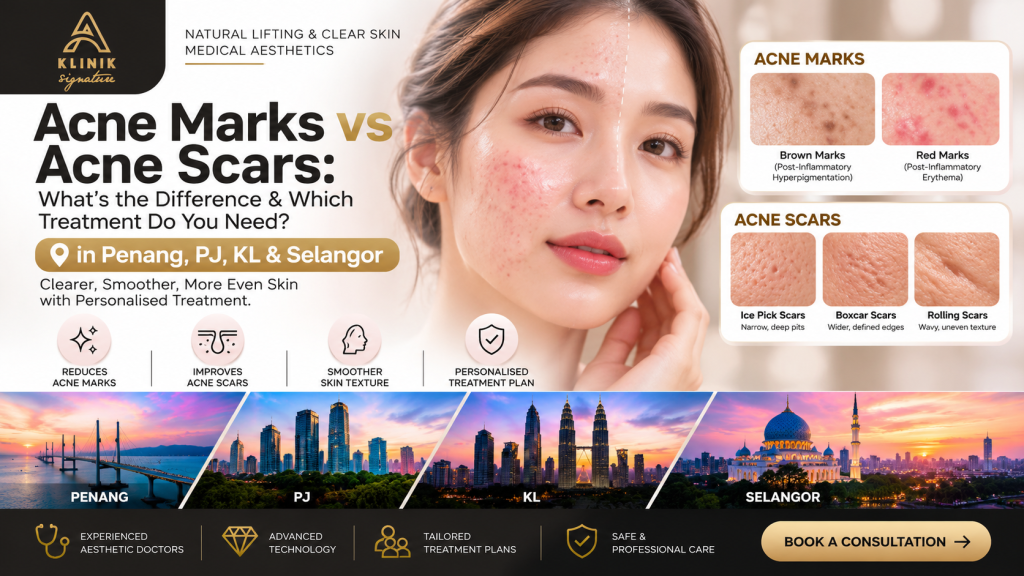


Acne Marks vs Acne Scars: What’s the Difference & Which Treatment Do You Need in Penang, PJ, KL & Selangor?
After acne improves, many people are left with red spots, brown marks, uneven skin texture or small indentations on their face. It is common to call all these concerns “acne scars”, but acne marks and acne scars are not necessarily the same problem.
Some are acne marks, which mainly affect skin colour after inflammation. Others are true acne scars, where the skin’s structure has changed.
Understanding the difference between acne marks vs acne scars is important because treatment approaches can be very different.
A treatment that helps fade brown acne marks may not significantly improve deep ice pick scars. Similarly, a treatment designed to remodel structural acne scars may not be the first priority for someone whose main concern is pigmentation.
For patients searching for acne marks treatment or acne scar treatment in Penang, PJ, KL & Selangor, identifying the type of post-acne concern is an important first step.
At A Klinik Signature, our Clear Skin approach considers active acne, pigmentation, redness, scar type, skin texture, enlarged pores and overall skin quality before developing a suitable treatment plan.
Acne Marks vs Acne Scars: What Is the Main Difference?
The easiest way to understand the difference is that acne marks mainly affect skin colour, while acne scars affect the structure or texture of the skin.
For example, if a pimple heals and leaves a flat brown spot, this is usually a post-inflammatory pigment change rather than an indented acne scar.
If acne heals and leaves a visible depression, uneven surface or raised area, structural scarring may be present.
However, both conditions can occur together. A patient may have brown acne marks, rolling scars, enlarged pores and active acne at the same time.
This is why an individual assessment is more useful than assuming that every post-acne concern requires the same treatment.
What Are Acne Marks?
Acne marks are flat areas of discolouration that remain after an acne lesion heals.
The skin surface may still feel relatively smooth, but the affected area looks darker, redder or different in colour from the surrounding skin.
There are two commonly discussed types of post-acne marks.
Post-Inflammatory Hyperpigmentation (PIH)
Post-inflammatory hyperpigmentation appears as brown, dark brown or greyish marks after acne-related inflammation.
When acne causes inflammation, the skin may produce excess pigment. Even after the acne lesion settles, this pigment can remain visible.
PIH can be particularly noticeable in medium to darker skin tones. Sun exposure may also make pigmentation appear darker or more persistent.
Post-Inflammatory Erythema (PIE)
Some acne marks appear pink, red or reddish-purple rather than brown.
These are often described as post-inflammatory erythema and are associated more with vascular changes following inflammation than excess melanin alone.
The distinction matters because red and brown acne marks may require different treatment strategies.
How Can I Tell If I Have Acne Marks?
Acne marks are usually:
- Flat rather than raised or depressed
- Red, pink, brown or greyish
- Located where previous acne occurred
- More noticeable because of colour than texture
- Relatively smooth when touched
One useful clue is to examine the skin under good lighting from different angles.
If the area looks different mainly because of colour, it may be an acne mark. If shadows appear because the skin is physically depressed, acne scarring may also be present.
A professional assessment is still recommended because pigmentation, redness and structural scars can overlap.
What Are Acne Scars?
True acne scars develop when inflammation damages the deeper structure of the skin and healing does not restore the tissue exactly as it was before.
Some scars occur when insufficient collagen forms during healing, leaving a depression.
Others develop when excessive scar tissue forms, creating raised scars.
This means acne scar treatment is often more complex than fading pigmentation. Treatment may need to address scar depth, fibrous attachments or collagen remodelling.
Why Does Acne Cause Scarring?
Not every acne breakout creates a scar.
The risk generally increases when inflammation is deeper or more severe. Inflammatory acne, including nodules and cysts, can damage surrounding tissue.
Several factors may influence scarring:
- Severity and depth of acne
- Duration of inflammation
- Individual healing response
- Genetics
- Picking or squeezing pimples
- Delayed treatment of severe inflammatory acne
Treating active acne is therefore important for reducing the risk of future scars.
Different Types of Acne Scars
There are several types of acne scars, and a person may have more than one type on the same face.
1. Ice Pick Scars
Ice pick scars are narrow, deep depressions that may resemble tiny puncture holes.
Although their openings appear small, these scars can extend deeper beneath the skin.
Because of their depth, surface-level treatments alone may have limited effects.
2. Boxcar Scars
Boxcar scars are wider depressions with relatively defined edges.
They may be shallow or deep and commonly appear on the cheeks and temples.
Their edges can create visible shadows, particularly under directional lighting.
3. Rolling Scars
Rolling scars create a wavy or uneven appearance.
In some cases, fibrous bands beneath the skin pull the surface downward. This is called tethering.
Treatment may need to address these underlying attachments rather than focusing only on the skin surface.
4. Hypertrophic and Keloid Scars
Not all acne scars are depressed.
Hypertrophic scars and keloids are raised scars caused by excess scar tissue.
Hypertrophic scars remain within the original injury area, while keloids may extend beyond it.
These scars require different management from ice pick, boxcar and rolling scars.
Acne Marks vs Acne Scars: Quick Comparison
| Feature | Acne Marks | Acne Scars |
|---|---|---|
| Main concern | Skin colour | Skin structure |
| Appearance | Red, pink, brown or greyish | Depressed, uneven or raised |
| Skin surface | Usually flat | Indented or raised |
| Examples | PIH and PIE | Ice pick, boxcar, rolling, keloid |
| Natural improvement | Some gradually fade | Structural scars generally persist |
| Treatment focus | Pigmentation or redness | Scar structure and remodelling |
For patients looking for acne marks treatment or acne scar treatment in Penang, PJ, KL & Selangor, understanding these differences helps establish realistic treatment priorities.
Are Brown Acne Marks Actually Scars?
Usually, a flat brown mark after acne is more consistent with post-inflammatory hyperpigmentation than structural scarring.
The original inflammation stimulates pigment production, and the pigment remains after the acne settles.
These marks may fade gradually, but the process can take time.
Factors such as sun exposure, repeated breakouts, skin tone and irritation can influence how long the marks remain visible.
Are Red Acne Marks Scars?
Flat red or pink marks are not necessarily scars either.
They may represent post-inflammatory erythema.
Although patients often call these “red acne scars”, the underlying skin structure may still be intact.
Redness, pigmentation and structural scarring should therefore be assessed separately.
Can Acne Marks Turn Into Acne Scars?
Acne marks do not normally transform into structural scars.
However, the same inflammatory acne lesion can leave both colour changes and a physical scar.
For example, a deep pimple may heal and leave a brown mark together with a depression.
Once the pigmentation improves, the underlying texture may become easier to evaluate.
Why Are My Acne Marks Taking So Long to Fade?
Post-acne marks do not disappear at the same speed for everyone.
Persistent marks may be associated with repeated acne, sun exposure, skin irritation, picking, inappropriate skincare or an individual tendency to develop pigmentation.
When new breakouts continue, new marks may appear before older ones fade.
For this reason, controlling active acne is often just as important as treating existing marks.
Does Squeezing Pimples Cause Acne Scars?
Picking and squeezing acne can increase inflammation and tissue damage.
This may increase the likelihood of post-inflammatory pigmentation and contribute to scarring, particularly with deeper inflammatory lesions.
Avoiding unnecessary trauma to pimples is an important part of acne care.
Do Acne Scars Get Worse With Age?
Acne scars do not necessarily become deeper simply because someone gets older.
However, changes in collagen, skin elasticity and facial structure may make depressed scars appear more noticeable.
Lighting also affects their appearance. Directional light can create shadows that make the same scar look significantly deeper.
Can Skincare Remove Acne Scars?
Skincare plays an important role in controlling acne, maintaining the skin barrier and improving pigmentation.
However, topical skincare generally cannot completely reconstruct a deep structural acne scar.
Patients with ice pick, boxcar or rolling scars may need scar-specific procedures, depending on suitability.
The key is choosing treatment according to the actual concern.
Can Acne Scars Be Completely Removed?
A realistic objective is improvement rather than guaranteeing completely scar-free skin.
Treatment may make scars shallower, improve texture and reduce their visibility.
Results depend on scar type, depth, number of scars, skin type, treatment choice, healing response and aftercare.
No treatment should guarantee perfectly smooth or poreless skin.
Acne Marks Treatment in Penang, PJ, KL & Selangor
For patients seeking acne marks treatment in Penang, PJ, KL & Selangor, the first priority is identifying whether the remaining marks are mainly brown pigmentation, persistent redness or a combination.
Depending on the condition, treatment may involve appropriate skincare, sun protection, acne management, selected chemical peels or suitable laser treatments.
Sunscreen for Acne Marks
Sun exposure can worsen post-inflammatory pigmentation and make brown marks more persistent.
Consistent sun protection supports pigmentation management and helps protect skin undergoing treatment.
However, sunscreen does not directly reconstruct indented acne scars.
Skincare for Acne Marks
A suitable skincare routine may help reduce breakouts, support the skin barrier and gradually improve uneven tone.
Using too many active ingredients together can cause irritation, potentially worsening pigmentation in susceptible skin.
The objective should be balanced skincare rather than unnecessarily aggressive treatment.
Vitamin C for Acne Marks
Vitamin C is commonly used in skincare for antioxidant support and improving the appearance of uneven skin tone.
It may be helpful as part of a suitable skincare routine, but it does not guarantee complete removal of acne marks or reconstruction of deep scars.
Chemical Peels for Acne Marks
Chemical peels use selected agents to create controlled exfoliation.
Certain peels may help suitable patients with superficial pigmentation, acne-related discolouration and texture.
However, aggressive peels may cause irritation or post-inflammatory pigmentation. Treatment strength should therefore be selected carefully.
Pico Laser for Acne Marks
Picosecond laser technology uses very short energy pulses and may be considered for selected pigmentation concerns.
Suitability depends on the device, treatment parameters, skin type and individual condition.
Not every acne mark requires Pico Laser, and Pico Laser is not automatically the best treatment for every structural acne scar.
Acne Scar Treatment: Improving Skin Structure
True acne scars require a different approach because the underlying skin structure has changed.
Depending on scar type, treatment may focus on collagen remodelling, releasing tethered scars, addressing deep individual scars or improving uneven texture.
Treatment for Ice Pick Scars
Ice pick scars are narrow and deep.
Selected focal procedures may be considered for suitable patients because superficial resurfacing alone may have limitations.
Treatment for Boxcar Scars
Shallow and deep boxcar scars may respond differently.
Treatment planning considers the scar depth, edges and overall skin condition. Resurfacing or collagen-remodelling approaches may be appropriate for selected cases.
Treatment for Rolling Scars
Rolling scars may involve fibrous attachments pulling the skin downward.
When tethering is present, treatment may need to address the underlying structural component.
Subcision for Acne Scars
Subcision is a procedure that may be considered for selected depressed scars, especially tethered rolling scars.
It involves releasing fibrous attachments beneath the skin.
Possible effects include swelling, bruising, tenderness and other procedure-related risks.
TCA CROSS for Acne Scars
TCA CROSS involves applying concentrated trichloroacetic acid to selected individual atrophic scars.
It is commonly discussed for certain narrow, deep scars such as ice pick scars.
Because it can cause pigmentation changes or other complications, careful patient selection and professional application are important.
Microneedling for Acne Scars
Microneedling creates controlled micro-injuries that stimulate a wound-healing response and collagen remodelling.
It may improve selected atrophic scars and uneven texture.
Results depend on scar type, depth, technique and individual healing response.
Laser Treatment for Acne Scars
Different laser technologies work in different ways.
Some may help improve scar appearance through controlled resurfacing or collagen remodelling.
However, the strongest laser is not automatically the best treatment.
Scar type, skin tone, pigmentation tendency, active acne and downtime tolerance should all be considered.
Can One Laser Treat Every Acne Scar?
Usually, no single treatment is ideal for every scar type.
Ice pick scars, rolling scars and boxcar scars have different structures.
Patients may also have pigmentation, enlarged pores and active acne at the same time.
A personalised combination strategy may therefore be considered rather than repeatedly using the same machine for every concern.
Combination Treatment for Acne Marks and Acne Scars
Combination treatment does not mean performing as many procedures as possible.
It means selecting complementary approaches that address different concerns.
A structured treatment plan might follow this sequence:
- Control active acne.
- Reduce inflammation and the risk of new scars.
- Address persistent pigmentation or redness.
- Treat selected structural scars.
- Improve pores and overall texture.
- Maintain the results with appropriate skincare.
The exact order depends on the patient’s condition.
Should Active Acne Be Treated Before Acne Scars?
In many cases, controlling significant active acne is an important priority.
If inflammatory acne continues, new marks and scars may form even while older scars are being treated.
This does not mean every procedure must wait until the skin has absolutely no acne. However, acne activity should be considered during treatment planning.
How Many Sessions Does Acne Scar Treatment Need?
There is no universal number of sessions.
The number depends on scar type, severity, treatment selection, healing response and desired improvement.
Deeper or mixed scars may require a longer treatment journey.
Patients should be cautious about claims that all acne scars can disappear in one session.
How Long Does It Take to See Results?
Scar improvement often involves collagen remodelling, which takes time.
Visible changes may develop gradually over weeks or months, depending on the procedure.
Some patients require multiple sessions with appropriate recovery intervals.
Is Acne Scar Treatment Painful?
Discomfort depends on the procedure.
Some treatments may cause mild stinging or heat, while more intensive procedures may require topical anaesthesia or other pain-management measures.
Temporary redness, swelling, tenderness or bruising may occur.
Is There Downtime After Acne Scar Treatment?
Downtime varies significantly.
Possible effects include redness, swelling, dryness, sensitivity, bruising, crusting or temporary darkening.
More intensive treatment may require longer recovery, but greater downtime does not automatically mean better results.
Can Acne Scar Treatment Cause Pigmentation?
Yes. Procedures that create inflammation can sometimes trigger post-inflammatory hyperpigmentation.
This is particularly relevant for patients who develop pigmentation easily.
Appropriate treatment selection, aftercare and sun protection can help reduce risk, but no procedure is completely risk-free.
Can Acne Scars Come Back?
A treated structural scar does not usually return in the same way that some pigmentation conditions recur.
However, new acne can create new scars, and previously treated scars may remain partially visible.
Long-term acne control is therefore important.
Acne Scars, Large Pores and Uneven Skin Texture
Patients with acne scars frequently also notice enlarged pores and uneven texture.
These concerns can overlap visually, especially under lighting that creates shadows.
However, pores are normal structures and cannot literally be removed or permanently closed.
Treatment may help make enlarged pores less noticeable while improving overall texture.
For patients with multiple concerns, an integrated Clear Skin approach may be more appropriate than treating each issue separately.
Why Choose A Klinik Signature for Acne Marks and Acne Scar Treatment?
At A Klinik Signature, our Clear Skin approach focuses on understanding the factors affecting skin clarity before planning treatment.
These may include active acne, pigmentation, redness, structural scars, enlarged pores and uneven skin texture.
Rather than selecting a procedure solely because it is popular, treatment planning considers the patient’s actual condition, suitability and realistic expectations.
For patients looking for acne marks treatment or acne scar treatment in Penang, PJ, KL & Selangor, this approach helps establish priorities and avoid treating every post-acne concern as the same problem.
Acne Marks and Acne Scar Treatment Locations
Penang — A Klinik Signature Greenlane
Patients in Penang seeking assessment for acne marks, acne scars and uneven skin texture can visit A Klinik Signature Greenlane.
Treatment recommendations depend on individual assessment and available services.
Petaling Jaya (PJ) — A Klinik Signature Damansara
Patients in PJ and surrounding Selangor areas can consider A Klinik Signature Damansara, located in Damansara Utama, Petaling Jaya.
Assessment can help distinguish between pigmentation, redness and structural acne scarring.
Kuala Lumpur (KL)
Patients travelling from Kuala Lumpur may consider A Klinik Signature Damansara in Petaling Jaya for aesthetic consultation.
Treatment planning should be based on scar type and suitability rather than assuming that every acne scar requires laser treatment.
Selangor
For patients across Selangor, A Klinik Signature Damansara provides a Petaling Jaya location for aesthetic assessment.
A personalised approach may help determine which post-acne concerns should be prioritised.
What Should I Ask Before Acne Scar Treatment?
Before starting treatment, patients should understand what type of marks or scars they have, why a particular treatment is recommended, the realistic improvement expected and the possible side effects.
It is also important to discuss the number of sessions, downtime, pigmentation risk and aftercare.
A good consultation should explain the treatment strategy rather than simply provide the name of a machine.
Frequently Asked Questions About Acne Marks vs Acne Scars
1. What is the difference between acne marks and acne scars?
Acne marks mainly involve skin colour changes, such as brown pigmentation or red marks. Acne scars involve structural changes, such as ice pick, boxcar or rolling scars. Both can occur together.
2. Can acne marks disappear on their own?
Some acne marks gradually fade, particularly when acne is controlled and the skin is protected from excessive sun exposure. However, the time required varies, and persistent marks may benefit from appropriate treatment.
3. What is the best treatment for acne scars?
There is no single best treatment for everyone. The appropriate approach depends on scar type, depth, skin condition and individual suitability. Mixed scars may require a combination of procedures.
4. Can Pico Laser remove acne marks and acne scars?
Pico Laser may be considered for selected pigmentation concerns and certain treatment applications, depending on the technology and settings. However, deep or tethered structural scars may require different approaches.
5. Where can I get acne marks and acne scar treatment in Penang, PJ, KL & Selangor?
Patients can seek an aesthetic assessment at A Klinik Signature Greenlane in Penang or A Klinik Signature Damansara in Petaling Jaya, Selangor. Patients travelling from KL can also consider the Damansara location. Treatment availability and suitability should be confirmed during consultation.
Conclusion
Understanding acne marks vs acne scars is an important first step before choosing treatment.
Flat brown or red marks are not necessarily structural scars. Likewise, ice pick, boxcar and rolling scars should not automatically receive identical treatment.
For patients looking for acne marks treatment or acne scar treatment in Penang, PJ, KL & Selangor, the treatment journey should begin with identifying the actual concern.
At A Klinik Signature, our Clear Skin approach considers acne activity, pigmentation, redness, scar type, enlarged pores, texture and overall skin quality.
The objective is realistic improvement towards clearer, smoother and more even-looking skin, rather than promising complete scar removal.
Medically Reviewed By Dr. Angeline