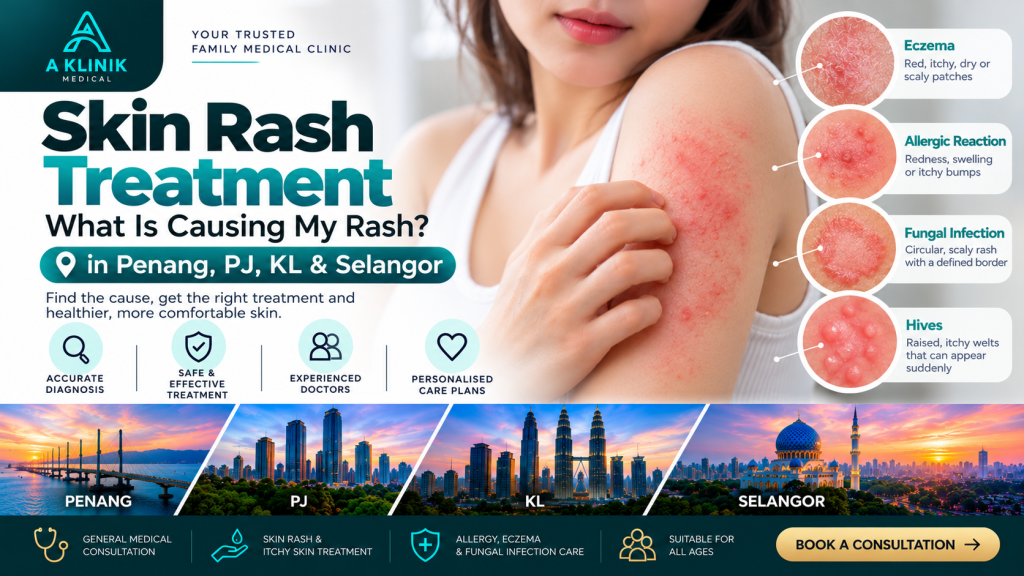


Skin Rash Treatment in Penang, PJ, KL & Selangor: What Is Causing My Rash?
A skin rash can appear suddenly or develop gradually over several days. It may look red, itchy, dry, swollen, bumpy, scaly, blistered or simply different from your normal skin.
For some people, a rash disappears quickly. For others, it keeps returning, spreads to different areas or becomes increasingly uncomfortable.
One of the biggest challenges is that many different skin conditions can look similar.
A red and itchy rash could be caused by eczema, an allergic reaction, contact dermatitis, fungal infection or another inflammatory skin condition. A circular rash may suggest a fungal infection, but not every round rash is fungal. A sudden widespread rash may be related to medication, infection or another medical condition.
This is why searching for skin rash pictures online and trying different creams may not always solve the problem.
For patients looking for skin rash treatment in Penang, PJ, KL & Selangor, understanding the cause is an important first step towards selecting appropriate treatment.
At A Klinik Medical, skin rash assessment focuses on identifying the likely cause, reviewing associated symptoms and recommending suitable medical care based on the patient’s condition.
What Is a Skin Rash?
A skin rash is a general term describing a noticeable change in the appearance or texture of the skin. It is not one specific medical diagnosis.
A rash may appear as:
- Red or inflamed patches
- Small bumps or raised welts
- Dry, flaky or scaly skin
- Blisters or fluid-filled lesions
- Swelling
- Crusting or peeling
- Circular or ring-shaped patches
- Darker or lighter areas of skin
- Rough or thickened skin
Some rashes are extremely itchy, while others cause burning, pain or tenderness. Certain rashes may remain visible for weeks without causing much discomfort.
Because a rash can have many appearances, identifying the underlying condition is more important than simply treating the redness.
What Causes a Skin Rash?
There are many possible causes of skin rashes.
Common causes include:
- Eczema
- Contact dermatitis
- Skin allergies
- Hives (urticaria)
- Fungal skin infections
- Bacterial or viral infections
- Psoriasis
- Heat rash
- Insect bites
- Irritation from skincare products
- Medication reactions
- Excessive sweating or friction
Sometimes the cause is relatively straightforward. For example, a rash that appears after using a new skincare product may be related to irritation or contact dermatitis.
However, other cases can be difficult to identify because several conditions produce similar symptoms.
Persistent, recurrent or worsening rashes should therefore be assessed rather than repeatedly treated through trial and error.
Why Is My Skin Rash Itchy?
Itching is one of the most common symptoms associated with skin rashes.
Inflammation and irritation can activate nerve pathways that create the sensation of itching.
Conditions commonly associated with itchy rashes include eczema, contact dermatitis, hives, fungal infections, insect bites and certain infections.
Scratching may provide temporary relief, but repeated scratching can damage the skin barrier.
Over time, this may contribute to increased inflammation, broken skin, bleeding, crusting, thickening, dark marks and secondary infection.
The goal of treatment should be to identify and manage the cause of the itching rather than relying only on temporary symptom relief.
Can You Have a Skin Rash Without Itching?
Yes. Not every skin rash causes itching.
Some rashes may produce redness, scaling, discolouration, blisters, tenderness, burning or pain without significant itching.
Whether a rash itches depends on the underlying condition and the individual’s skin response.
A rash should not automatically be considered harmless simply because it does not itch.
If a non-itchy rash persists, spreads, changes appearance or occurs with other symptoms, medical assessment may be appropriate.
Why Did My Skin Rash Appear Suddenly?
A sudden skin rash may be associated with an allergic reaction, hives, contact with an irritant, a new skincare product, medication, insect bites, heat, sweating or infection.
When a rash appears unexpectedly, consider what happened before the symptoms started.
Useful questions include:
- Did you start a new medication?
- Did you change your body wash or skincare?
- Did you use a new laundry detergent?
- Were you exposed to chemicals or plants?
- Did you spend time in a hot environment?
- Did you develop fever or feel unwell?
- Did you recently travel or stay somewhere new?
These details can help a doctor identify possible triggers.
However, not every sudden rash is caused by an allergy.
Is a Red Skin Rash Always an Allergy?
No. Redness can occur with many different skin conditions.
A red rash may be associated with eczema, contact dermatitis, fungal infection, hives, bacterial infection, viral illness, psoriasis, heat rash or simple irritation.
Taking antihistamines or using an allergy cream may not address the underlying problem if the cause is different.
This is why correct diagnosis matters before selecting treatment.
Could My Rash Be Eczema?
Eczema is a common inflammatory skin condition that can cause recurrent itching and irritation.
Depending on the individual and stage of the condition, eczema may appear dry, red, rough, scaly, cracked or thickened.
Some people experience repeated flare-ups affecting similar areas.
Possible aggravating factors include heat, sweating, dry skin, fragrances, irritating skincare products and stress.
Eczema management often involves reducing inflammation, supporting the skin barrier, avoiding relevant triggers and managing flare-ups.
Patients with recurring symptoms may benefit from a medical assessment and an appropriate maintenance plan.
Could My Rash Be a Skin Allergy?
Possibly. However, the term skin allergy can describe different conditions.
One example is allergic contact dermatitis, which occurs when the immune system reacts to a substance contacting the skin.
Potential triggers include fragrances, preservatives, metals, cosmetics, hair products, adhesives and chemicals.
A rash may appear in the area of exposure, although the distribution can vary.
Importantly, an allergic reaction may develop even after a person has used a product for a long time without previous problems.
Identifying the responsible trigger can be an important part of preventing repeated reactions.
Irritant Contact Dermatitis vs Allergic Contact Dermatitis
These two conditions may look similar, but their underlying mechanisms are different.
| Irritant Contact Dermatitis | Allergic Contact Dermatitis |
|---|---|
| Caused by direct irritation or damage to the skin barrier | Caused by an immune reaction to a particular substance |
| May be triggered by harsh soaps, detergents, repeated washing or chemicals | May be triggered by certain metals, fragrances, preservatives or other allergens |
| Can occur without a true allergy | Involves allergic sensitisation |
| Often managed by reducing irritation and protecting the skin barrier | Often requires identifying and avoiding the allergen |
Both conditions may cause redness, itching, dryness, scaling and inflammation.
The patient’s exposure history can help guide assessment and treatment.
Could My Rash Be Hives?
Hives, also known as urticaria, typically appear as raised, swollen welts on the skin.
They may be intensely itchy, change shape and disappear from one area while appearing elsewhere.
Hives can be associated with infections, medications, foods and other triggers. However, a specific cause is not always identifiable.
Not every episode of hives indicates a food allergy.
If hives are accompanied by breathing difficulty, swelling of the tongue or throat, fainting or severe dizziness, emergency medical attention is required.
Could My Rash Be a Fungal Infection?
Yes. Fungal skin infections are common in warm and humid environments.
They may affect the body, groin, feet, scalp and skin folds.
Certain fungal infections can appear as circular, scaly or itchy patches.
However, eczema and other inflammatory skin conditions may resemble fungal rashes.
This is important because inappropriate use of steroid-containing creams can temporarily reduce redness while changing the appearance of an untreated fungal infection.
If a rash is persistent, spreading or repeatedly returning, medical assessment may help determine whether antifungal treatment is appropriate.
Why Malaysia’s Hot and Humid Weather Can Affect Skin Rashes
Malaysia’s climate can contribute to sweating, moisture accumulation, friction and skin irritation.
These conditions may aggravate eczema, encourage certain fungal infections or contribute to heat rash.
For example, someone who develops a rash after sweating may have heat rash, eczema aggravated by sweat or a fungal infection.
Although the symptoms may appear similar, the treatment can be different.
For patients in Penang, PJ, KL & Selangor, recognising the role of heat and humidity may help with prevention, but climate alone should not be used to diagnose a rash.
Could My Rash Be a Skin Infection?
Skin infections may be caused by bacteria, fungi or viruses.
Possible signs of infection include:
- Increasing pain or tenderness
- Warmth and swelling
- Pus or discharge
- Crusting
- Rapidly spreading redness
- Fever
- Feeling generally unwell
Different infections require different treatment approaches.
Antibiotics do not treat fungal infections, while antifungal medication does not treat bacterial infections.
A painful, rapidly spreading rash, particularly with fever, should be assessed promptly.
Can Psoriasis Look Like a Skin Rash?
Yes. Psoriasis is a chronic inflammatory skin condition that may produce well-defined, scaly patches or plaques.
It can affect the scalp, elbows, knees, trunk, skin folds and other areas.
Psoriasis may sometimes resemble eczema or fungal infection.
Because psoriasis is often a long-term condition, diagnosis and ongoing management are important.
Is Heat Rash Common in Malaysia?
Heat rash can occur when sweat ducts become blocked, particularly in hot and humid conditions.
It may appear as small bumps and cause itching, prickling or discomfort.
Areas where clothing traps heat or sweating is heavier may be affected.
However, a persistent rash should not automatically be labelled heat rash simply because the weather is hot.
If symptoms continue, spread or repeatedly return, another cause may need to be considered.
Does the Location of a Skin Rash Matter?
Yes. The location and distribution of a rash can help narrow down possible causes.
Doctors may assess whether the rash affects the face, neck, scalp, hands, arms, legs, chest, back, groin, armpits, skin folds, feet or multiple body areas.
They may also consider whether the rash is symmetrical, appears on exposed skin or follows areas of contact with jewellery, clothing or personal-care products.
Location alone cannot confirm a diagnosis, but it can provide useful information when combined with symptoms and medical history.
What Causes a Rash on the Face?
Facial rashes may be associated with contact dermatitis, skincare irritation, eczema, allergies, infections or other inflammatory conditions.
A common mistake is adding more skincare products when irritation develops.
Strong acids, scrubs, exfoliating products, multiple serums and harsh cleansers may worsen already irritated skin.
Reviewing recent changes to skincare, makeup, sunscreen and hair products may help identify possible triggers.
Why Do I Have a Rash on My Hands?
Hand rashes may develop because the hands are frequently exposed to water, soap, sanitiser, detergents and chemicals.
Possible causes include irritant contact dermatitis, allergic contact dermatitis, hand eczema and fungal infection.
Symptoms may include dryness, redness, itching, cracking, peeling or small blisters.
Reducing relevant exposures and supporting the skin barrier may be important parts of management.
What Causes a Rash in the Groin or Skin Folds?
Groin and skin-fold rashes may be associated with fungal infections, friction, sweating, moisture, contact dermatitis or other inflammatory conditions.
Warm, moist environments can aggravate some of these problems.
However, not every groin rash is fungal.
A recurring or persistent rash should be assessed before repeatedly applying medication.
What Does a Circular Skin Rash Mean?
A circular or ring-shaped rash may suggest ringworm, a fungal skin infection.
However, other conditions can also produce round or ring-like patches.
A circular appearance alone is not enough to confirm a fungal infection.
If the rash spreads or fails to improve, medical assessment may be appropriate.
Why Is My Rash Spreading?
A rash may spread because of ongoing exposure to an irritant, infection, progression of an inflammatory condition, scratching or a medication reaction.
The speed of spread is important.
A patch that gradually enlarges over several weeks is different from redness spreading rapidly over a few hours.
Rapidly spreading redness associated with pain, warmth, swelling, fever or feeling unwell requires prompt medical attention.
Why Does My Rash Keep Coming Back?
Recurring rashes may occur when the underlying condition is chronic, the trigger remains present or treatment has not fully addressed the cause.
Other possibilities include incomplete treatment, reinfection, an incorrect diagnosis, persistent skin barrier damage or repeated exposure to heat and friction.
If a rash improves temporarily with a cream but returns after treatment stops, the diagnosis or long-term management plan may need reassessment.
Can Medication Cause a Skin Rash?
Yes. Some medications can cause skin reactions.
If a rash appears after starting a new medication, inform your doctor about the medication name, when it was started, when the rash appeared and whether there are other symptoms.
Patients should not stop important prescribed medication without appropriate medical advice.
Severe reactions involving widespread blistering, skin peeling, mouth or eye involvement, facial swelling or breathing difficulty require urgent medical attention.
Is a Skin Rash Contagious?
Some skin rashes are contagious, while others are not.
Certain fungal, bacterial and viral infections can spread between people.
Eczema and psoriasis are not contagious.
This distinction matters because the diagnosis determines whether additional precautions may be necessary.
How Does a Doctor Diagnose a Skin Rash?
A medical consultation usually begins with reviewing the patient’s symptoms and examining the skin.
The doctor may consider:
- When the rash started
- Where it first appeared
- Whether it has spread
- Whether it itches, burns or hurts
- Whether it comes and goes
- Recent medication use
- Skincare and personal-care products
- Occupational or environmental exposures
- Previous skin conditions
- Treatments already attempted
- Associated fever or other symptoms
The skin may be examined for its colour, shape, borders, scaling, blisters, swelling, crusting and distribution.
Photographs taken during an earlier flare-up may also be useful if the rash changes before the consultation.
Do I Need a Test for My Skin Rash?
Many skin rashes can be assessed through clinical examination and medical history.
However, selected investigations may be considered when the diagnosis is uncertain, the condition is recurrent or treatment is not producing the expected response.
Depending on the situation, this may involve testing for suspected fungal or bacterial infection, contact allergy or another underlying condition.
Not every patient requires laboratory testing.
Skin Rash Treatment in Penang, PJ, KL & Selangor
There is no single best cream for every skin rash.
The appropriate treatment depends on the underlying diagnosis, severity, affected area and individual medical suitability.
At A Klinik Medical, the objective is to identify the likely cause before discussing treatment options.
1. Anti-Inflammatory Treatment
Certain inflammatory skin conditions, including eczema, may require appropriately selected anti-inflammatory medication.
The type and strength of treatment depend on the diagnosis and affected area.
2. Antifungal Treatment
Fungal skin infections may require topical or, in selected cases, oral antifungal medication.
Treatment duration depends on the type and severity of infection.
3. Antibacterial Treatment
Bacterial skin infections may require appropriate antimicrobial treatment.
However, not every red or crusted rash needs antibiotics.
4. Antihistamines
Antihistamines may be useful for selected conditions, particularly hives.
They do not treat every underlying cause of skin rash.
5. Moisturisers and Skin Barrier Care
Moisturisers can help when dryness and skin barrier disruption contribute to inflammation.
This is particularly relevant for eczema and irritant dermatitis.
6. Trigger Avoidance
When a particular irritant or allergen is identified, avoiding repeated exposure may help reduce future episodes.
7. Follow-Up and Reassessment
Follow-up may be appropriate when a rash does not improve as expected, spreads or repeatedly returns.
The treatment plan may need adjustment based on the patient’s response.
Should I Use Steroid Cream for a Rash?
Topical corticosteroids can be effective for certain inflammatory skin conditions when used appropriately.
However, they are not suitable for every rash.
Using steroid cream without knowing the diagnosis can sometimes cause problems, particularly when a fungal infection is present.
Medication strength, treatment area and duration should be selected according to the patient’s condition.
Stronger medication is not automatically better.
What About Combination Creams?
Some creams combine corticosteroids, antifungals or antibiotics.
Patients may assume that a combination product is better because it contains several medications.
However, unnecessary ingredients may expose the skin to treatments it does not need.
A more appropriate approach is to identify the condition and select treatment based on the diagnosis.
Do I Need Antibiotics for a Skin Rash?
Not automatically.
Antibiotics are used for bacterial infections when medically appropriate.
They do not treat eczema, fungal infections, psoriasis, most allergic rashes or simple irritation.
Unnecessary antibiotic use should be avoided.
Can Moisturiser Help a Skin Rash?
Moisturiser may help when dryness or skin barrier damage contributes to the condition.
It is particularly useful as part of management for some patients with eczema or irritant dermatitis.
However, moisturiser is supportive care rather than a universal treatment.
It cannot replace appropriate medication when an infection or another condition requires specific treatment.
Should I Stop All Skincare When I Have a Rash?
Not necessarily.
However, simplifying the skincare routine may be useful when irritation is suspected.
Temporarily avoiding strong exfoliants, scrubs, fragrances and unnecessary active ingredients may help reduce additional irritation.
The appropriate skincare routine depends on the diagnosis and skin condition.
Can Diet or Stress Cause a Skin Rash?
Certain foods may trigger allergic reactions in susceptible individuals, but not every recurring rash is caused by diet.
Unnecessary elimination diets should be avoided without a clear medical reason.
Stress may also worsen some inflammatory skin conditions, including eczema.
However, a persistent rash should not automatically be dismissed as stress-related without considering other causes.
Can a Skin Rash Leave Dark Marks or Scars?
Yes. Inflammation can sometimes leave post-inflammatory hyperpigmentation after a rash improves.
Dark marks are not necessarily permanent structural scars.
Scarring may be more likely when the skin experiences deep injury, severe inflammation, infection or repeated scratching.
Controlling the underlying condition and avoiding further skin damage are important first steps.
How Long Does a Skin Rash Take to Go Away?
Recovery time varies depending on the cause.
A mild irritant rash may improve after the trigger is removed, while fungal infections may require an adequate course of treatment.
Chronic conditions such as eczema and psoriasis may improve but can flare again.
Treatment response depends on the diagnosis, severity, affected area, duration, medication and individual patient factors.
If a rash is not improving as expected, reassessment may be necessary.
How Can I Prevent Recurrent Skin Rashes?
Prevention depends on the underlying condition.
General measures may include:
- Using gentle cleansers
- Moisturising dry or eczema-prone skin
- Avoiding known irritants
- Reducing unnecessary exfoliation
- Managing sweat and moisture
- Changing out of wet clothing
- Avoiding unnecessary sharing of personal items when infection is suspected
- Following prescribed treatment correctly
- Attending follow-up when symptoms recur
Patients with chronic skin conditions may require an individualised maintenance plan.
When Should You See a Doctor for a Skin Rash?
Medical assessment may be appropriate when a rash:
- Persists or repeatedly returns
- Continues spreading
- Is severely itchy or painful
- Develops pus or significant crusting
- Does not improve with previous treatment
- Appears after starting medication
- Affects sleep or daily activities
- Occurs with fever or feeling unwell
- Has an unclear cause
For patients seeking skin rash treatment in Penang, PJ, KL & Selangor, timely medical assessment may help identify the likely condition and guide appropriate treatment.
When Is a Skin Rash an Emergency?
Seek emergency medical care if a rash is accompanied by:
- Difficulty breathing or wheezing
- Tongue or throat swelling
- Fainting or severe dizziness
- Extensive blistering or skin peeling
- Mouth or eye involvement with a severe reaction
- Severe illness or a rapidly worsening condition
Rapidly spreading painful redness with fever also requires prompt medical assessment.
These symptoms should not wait for a routine clinic appointment.
Why Choose A Klinik Medical for Skin Rash Treatment?
Skin rashes can have many different causes, and similar-looking symptoms do not always require the same treatment.
At A Klinik Medical, the approach focuses on assessing the rash before selecting treatment.
Patients may seek consultation for itchy skin, eczema, contact dermatitis, skin allergies, fungal infections, psoriasis and other common rash-related concerns.
A medical assessment may involve reviewing the rash pattern, symptoms, relevant medical history, potential triggers and previous treatment.
The objective is to provide an appropriate treatment plan, explain the condition and arrange follow-up where necessary.
Skin Rash Treatment Locations: Penang, PJ, KL & Selangor
Skin Rash Treatment in Penang
Patients in Penang experiencing persistent, recurrent or spreading skin rashes may consider medical assessment at A Klinik Medical.
The clinic network includes locations in Jelutong, Bayan Lepas, Relau and Raja Uda.
Skin Rash Treatment in PJ (Petaling Jaya)
Patients searching for skin rash treatment in PJ can consider medical assessment through the wider A Klinik Medical network in Klang Valley.
The clinic network should not be confused with A Klinik Signature’s aesthetic branch in Petaling Jaya.
Skin Rash Treatment in KL (Kuala Lumpur)
Patients in Kuala Lumpur may consider the A Klinik Medical Cheras location for consultation, subject to current branch services and availability.
Skin Rash Treatment in Selangor
A Klinik Medical’s wider Selangor network includes Puchong, Klang and Gombak.
Patients should confirm the current operating status and available services before visiting.
For updated clinic details, visit the A Klinik clinic locations page.
Frequently Asked Questions About Skin Rash Treatment
1. What Is the Most Common Cause of a Skin Rash?
There is no single cause of every skin rash. Common possibilities include eczema, contact dermatitis, allergies, fungal infections, heat rash and other inflammatory or infectious conditions. The likely cause depends on the appearance, location, symptoms and medical history.
2. How Do I Know if My Rash Is Fungal or Eczema?
Fungal infections and eczema can sometimes look similar. Certain fungal rashes may have scaling or expanding borders, but appearance alone is not always reliable. Medical assessment may be necessary, particularly when a rash persists or repeatedly returns.
3. When Should I See a Doctor for a Skin Rash?
Consider seeing a doctor if the rash persists, spreads, becomes painful, repeatedly returns or develops signs of infection. Seek emergency care for severe allergic symptoms, extensive blistering or significant skin peeling.
4. Why Does My Skin Rash Keep Coming Back After Using Cream?
The trigger may still be present, the underlying condition may be chronic, treatment may have been incomplete or the original diagnosis may need reconsideration. Some creams temporarily reduce redness without treating the underlying cause.
5. Can a Skin Rash Go Away Without Treatment?
Some mild rashes improve when the trigger disappears. Others require medical treatment. Persistent, worsening or recurring rashes should be assessed.
Conclusion
A skin rash is a symptom, not one specific diagnosis.
It may be caused by eczema, contact dermatitis, allergies, fungal infection, bacterial or viral infection, psoriasis, heat rash, medication reactions or other conditions.
This is why the same cream should not be used for every red or itchy rash.
For patients looking for skin rash treatment in Penang, PJ, KL & Selangor, medical assessment can help identify the likely cause and guide a suitable treatment plan.
At A Klinik Medical, the focus is on individual medical assessment, appropriate treatment, patient education and follow-up when necessary.
The goal is not simply to hide the rash temporarily. It is to understand the condition behind it and manage it appropriately.