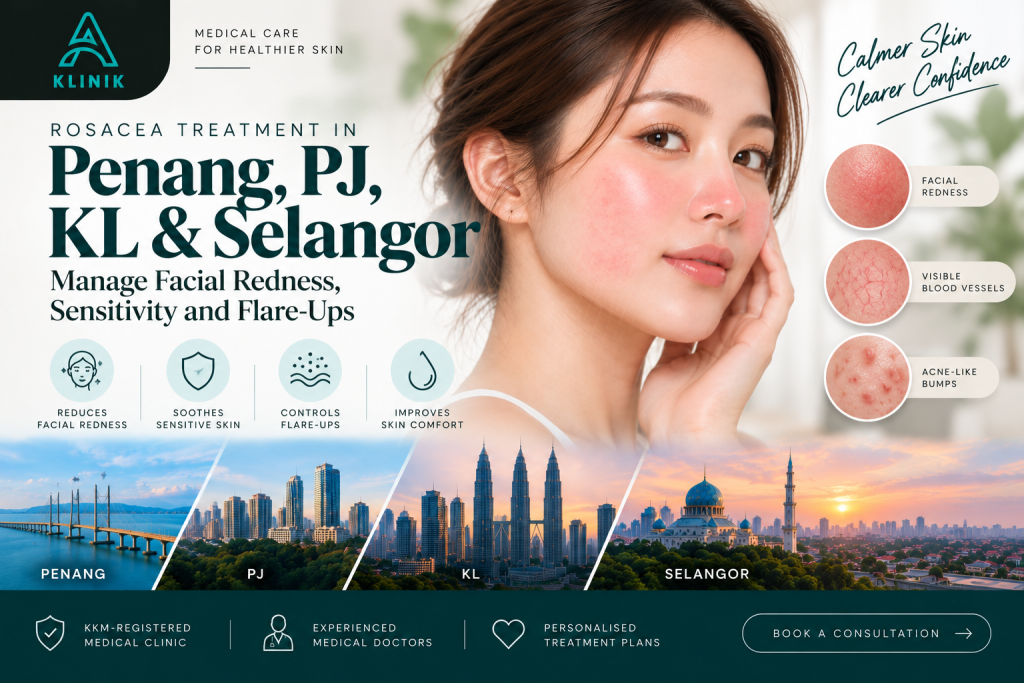


Rosacea Treatment in Penang, PJ, KL & Selangor: Causes, Symptoms & How to Manage Facial Redness
Introduction
Persistent facial redness is often dismissed as sensitive skin, frequent blushing or even acne. However, for many people, it may actually be rosacea, a chronic inflammatory skin condition that commonly affects the central face.
Rosacea is more than a cosmetic concern. It may cause persistent redness, visible blood vessels, acne-like bumps, skin sensitivity, burning sensations and recurring flare-ups that affect both appearance and confidence.
Although symptoms may come and go, rosacea is generally a long-term condition that benefits from early diagnosis and appropriate medical management.
If you’re searching for rosacea treatment in Penang, PJ, KL & Selangor, obtaining an accurate diagnosis is an important first step. Rosacea is often mistaken for acne, eczema, allergic skin reactions or sensitive skin, which may delay appropriate treatment.
At A Klinik Medical, our medical doctors provide personalised assessment and medical management for patients experiencing persistent facial redness and other skin concerns.
Our approach focuses on identifying potential triggers, reducing inflammation, controlling flare-ups and helping patients maintain healthier skin over the long term.
In this guide, we’ll explain what rosacea is, its common causes, symptoms, treatment options and when you should consult a doctor.
What Is Rosacea?
Rosacea is a chronic inflammatory skin condition that primarily affects the face.
It most commonly involves the cheeks, nose, chin and forehead, although some patients may also experience symptoms affecting the eyes.
Unlike acne, rosacea is not primarily caused by blocked pores. Instead, it involves a combination of inflammation, increased skin sensitivity, vascular changes and other biological factors.
The condition often develops gradually. Some patients initially experience episodes of facial flushing before developing more persistent redness or other symptoms.
Common features of rosacea include:
- Persistent facial redness
- Frequent flushing
- Visible blood vessels
- Acne-like bumps and pimples
- Burning or stinging sensations
- Sensitive skin
- Dry or rough skin
- Eye irritation in some patients
Although rosacea cannot currently be permanently cured, appropriate treatment can help control symptoms, reduce flare-ups and improve quality of life.
Is Rosacea Contagious?
No. Rosacea is not contagious.
It cannot spread through touching, hugging, sharing personal items or normal close contact with another person.
Rosacea is an inflammatory skin condition rather than an infectious disease.
What Causes Rosacea?
One of the most common questions patients ask is:
“Why is my face always red?”
The exact cause of rosacea is not fully understood. However, research suggests that genetic, immune-system, vascular and environmental factors may contribute to its development.
Rosacea triggers also vary between individuals.
Understanding your personal triggers is an important part of long-term management.
Genetics
Rosacea may occur more frequently in individuals with a family history of the condition.
Although genetics alone does not determine whether someone develops rosacea, inherited factors may increase susceptibility.
Overactive Immune Response
Research suggests that abnormal immune activity contributes to inflammation in rosacea.
This inflammatory response may make the skin more reactive to environmental factors and other triggers.
Changes in Blood Vessels
Many patients with rosacea experience increased blood-vessel reactivity.
Triggers such as heat, spicy food, alcohol or emotional stress may cause facial flushing.
Some patients also develop persistently visible small blood vessels, known as telangiectasia.
Environmental Factors
Environmental conditions can trigger or aggravate rosacea symptoms in susceptible individuals.
Common examples include:
- Sun exposure
- Hot weather
- Cold wind
- High humidity
- Sudden temperature changes
Because Malaysia has a warm and humid climate, some patients may notice increased flushing or discomfort after spending time outdoors.
Lifestyle Triggers
Commonly reported rosacea triggers include:
- Spicy food
- Hot drinks
- Alcohol
- Emotional stress
- Vigorous exercise
- Certain skincare products
- Fragrances
- Smoking
Not every patient reacts to the same triggers.
Rather than avoiding every possible trigger, it is generally more useful to identify the factors that consistently worsen your own symptoms.
Common Symptoms of Rosacea
Rosacea symptoms differ from one person to another.
Some individuals experience occasional flushing, while others develop persistent redness, visible blood vessels or inflammatory bumps.
Recognising these symptoms can help patients seek appropriate assessment.
Persistent Facial Redness
One of the most recognisable signs of rosacea is persistent redness affecting the central face.
Common areas include:
- Cheeks
- Nose
- Chin
- Forehead
Unlike temporary blushing, the redness may remain even after the original trigger has disappeared.
The appearance of redness can also vary according to natural skin tone.
Frequent Flushing
Many patients experience sudden episodes of facial flushing after exposure to heat, spicy food, alcohol, emotional stress or exercise.
These episodes may initially be temporary.
Over time, some patients develop more persistent facial redness.
Visible Blood Vessels
Small, dilated blood vessels may become visible beneath the skin surface, particularly around the cheeks and nose.
These fine lines are known as telangiectasia.
They are a common feature of rosacea, although not every patient develops them.
Acne-Like Bumps
Some patients develop inflammatory bumps or pus-filled lesions that resemble acne.
However, rosacea typically does not produce the blackheads and whiteheads commonly associated with acne vulgaris.
Because the two conditions can look similar, accurate diagnosis is important before starting treatment.
Sensitive Skin
Many people with rosacea describe their skin as:
- Easily irritated
- Dry
- Tight
- Burning
- Stinging
Products that are well tolerated by other people may cause discomfort in rosacea-prone skin.
This is why aggressive exfoliation or frequently changing skincare products may not be appropriate.
Ocular Rosacea
Rosacea may also affect the eyes.
Possible symptoms include:
- Dry eyes
- Red eyes
- Watery eyes
- Burning sensations
- Light sensitivity
- Eyelid irritation
Patients experiencing eye symptoms should seek medical assessment promptly.
Eye pain, reduced vision or significant light sensitivity requires urgent assessment because eye involvement can sometimes threaten vision.
Rosacea vs Acne: What’s the Difference?
One reason rosacea is frequently mismanaged is that patients mistake it for acne.
Although both conditions may produce inflammatory bumps, they have different underlying processes and may require different treatments.
| Rosacea | Acne |
|---|---|
| Persistent facial redness may occur | Comedones and inflammatory lesions are common |
| Frequent flushing | Blackheads and whiteheads |
| Visible facial blood vessels | Blocked hair follicles |
| Burning or sensitive skin may occur | Oil production and follicular blockage contribute |
| Commonly affects the central face | May affect face, chest, back and shoulders |
| Often aggravated by heat and other individual triggers | Influenced by hormones, oil production and inflammation |
These are general differences rather than a reliable way to diagnose yourself.
Some patients can also have acne and rosacea at the same time.
Certain acne products, particularly irritating or drying products, may worsen discomfort in rosacea-prone skin.
If you’re unsure whether your symptoms are caused by acne or rosacea, a medical consultation can help determine the appropriate treatment approach.
Rosacea vs Eczema
Rosacea is also commonly confused with eczema because both conditions may cause red, irritated and sensitive skin.
However, their typical patterns differ.
| Rosacea | Eczema |
|---|---|
| Commonly affects the central face | Can affect different parts of the body |
| Facial flushing is common | Itching is often prominent |
| Visible blood vessels may develop | Dryness and skin-barrier dysfunction are common |
| May cause acne-like bumps | May cause dry, inflamed or cracked patches |
| Burning or stinging may occur | Itching and irritation are common |
These conditions can overlap in appearance.
Eczema, contact dermatitis, seborrhoeic dermatitis and other conditions may also affect the face.
Because treatment differs, accurate medical assessment is important.
How Is Rosacea Diagnosed?
There is currently no single laboratory test that confirms every case of rosacea.
Diagnosis is usually based on medical history and clinical examination.
At A Klinik Medical, our doctors may assess:
- Your skin symptoms
- Facial redness pattern
- Flushing history
- Medical history
- Family history
- Previous treatments
- Skincare products
- Lifestyle factors
- Possible triggers
During consultation, your doctor may also consider other skin conditions that can resemble rosacea, including:
- Acne vulgaris
- Eczema
- Seborrhoeic dermatitis
- Lupus
- Allergic contact dermatitis
Further assessment may be needed when the diagnosis is uncertain.
An accurate diagnosis helps determine appropriate rosacea treatment rather than relying solely on trial-and-error skincare products.
Rosacea Treatment Options in Penang, PJ, KL & Selangor
Although rosacea cannot currently be permanently cured, many patients can achieve meaningful symptom control with appropriate treatment and lifestyle adjustments.
Treatment should be personalised according to:
- Rosacea symptoms and clinical features
- Severity
- Skin sensitivity
- Individual triggers
- Medical history
- Previous treatments
- Presence of eye symptoms
Different rosacea symptoms may require different approaches.
For example, treatment for inflammatory bumps may differ from treatment for persistent redness or visible blood vessels.
Prescription Medications
Depending on your symptoms and medical history, your doctor may prescribe appropriate topical or oral medication.
Treatment may aim to:
- Reduce inflammation
- Control acne-like bumps
- Improve persistent redness where appropriate
- Reduce flare-ups
- Improve skin comfort
Medication selection depends on the individual condition.
Your doctor should explain how to use prescribed treatment and what results or side effects to expect.
Medical Skincare
Rosacea-prone skin often experiences increased sensitivity and skin-barrier problems.
Your doctor may recommend a gentle skincare routine designed to:
- Support the skin barrier
- Reduce irritation
- Maintain hydration
- Protect sensitive skin
A suitable routine does not necessarily require many products.
Gentle cleansing, moisturising and sun protection are often important foundations of rosacea skincare.
Trigger Management
Identifying and managing personal triggers is an important part of long-term rosacea care.
Common triggers include:
- Sun exposure
- Hot weather
- Spicy food
- Alcohol
- Emotional stress
- Vigorous exercise
- Hot beverages
- Certain skincare products
Because triggers vary, keeping a simple record of flare-ups may help you identify patterns.
Your doctor can discuss practical adjustments based on your individual experience.
Daily Sun Protection
UV exposure is a commonly reported rosacea trigger.
Patients are generally advised to:
- Use suitable broad-spectrum sunscreen
- Avoid prolonged direct sun exposure
- Wear a hat or use an umbrella outdoors
- Reapply sunscreen when appropriate
For sensitive skin, choosing a sunscreen that does not cause burning or stinging is also important.
Long-Term Follow-Up
Rosacea is a chronic condition, meaning symptoms may improve and recur over time.
Follow-up appointments allow your doctor to:
- Monitor symptoms
- Review treatment response
- Adjust medication where necessary
- Discuss skincare tolerance
- Review personal triggers
Long-term management is often more useful than treating each flare-up as an unrelated episode.
Can Rosacea Be Prevented?
Because the exact cause of rosacea is not fully understood, it cannot always be prevented.
However, many patients can reduce flare-ups by managing known triggers and maintaining a suitable skincare routine.
Helpful habits include:
- Applying sunscreen daily
- Using gentle cleansers
- Moisturising regularly
- Avoiding harsh exfoliants
- Identifying personal triggers
- Limiting excessive sun exposure
- Managing stress where possible
- Following prescribed treatment
These measures can help support skin comfort and long-term symptom control.
When Should You See a Doctor for Rosacea?
Many people delay seeking treatment because they believe persistent redness is simply part of having sensitive skin.
You should consider medical assessment if you experience:
- Persistent facial redness
- Frequent flushing
- Visible blood vessels
- Acne-like bumps that do not improve
- Burning or stinging skin
- Increasing skin sensitivity
- Eye irritation associated with facial redness
- Symptoms that persist despite changing skincare products
Early assessment can help distinguish rosacea from other conditions and reduce unnecessary or inappropriate treatment.
For patients seeking rosacea treatment in Penang, PJ, KL & Selangor, a medical consultation can help identify the cause of persistent facial redness and determine an appropriate management plan.
Rosacea Treatment in Penang
Patients looking for rosacea treatment in Penang may experience concerns such as persistent facial redness, recurring flushing, sensitive skin or inflammatory bumps.
A Klinik Medical has clinics serving patients across Penang, including Jelutong, Bayan Lepas, Raja Uda and Relau.
Medical assessment can help distinguish rosacea from acne, eczema, contact dermatitis and other skin conditions before appropriate treatment is recommended.
Rosacea Treatment in PJ
Patients searching for rosacea treatment in PJ or Petaling Jaya may benefit from assessment when facial redness, flushing or skin sensitivity continues despite changes to their skincare routine.
A Klinik Medical’s wider Klang Valley network serves patients across Selangor and surrounding areas.
Treatment should be based on the individual diagnosis, symptoms and medical history rather than assuming every case of facial redness is caused by sensitive skin.
Rosacea Treatment in KL
For patients looking for rosacea treatment in KL, persistent redness, visible blood vessels or recurring inflammatory bumps may require medical assessment.
A Klinik Medical’s Klang Valley network includes Cheras and other locations serving the wider area.
The objective is to identify the underlying condition and recommend an appropriate management plan.
Rosacea Treatment in Selangor
Patients seeking rosacea treatment in Selangor can consider medical assessment for persistent facial redness, frequent flushing and other symptoms.
A Klinik Medical’s Klang Valley locations include Puchong, Klang and Gombak.
Treatment planning considers the patient’s symptoms, skin sensitivity, medical history, possible triggers and previous treatment response.
Why Choose A Klinik Medical for Rosacea Treatment?
Choosing a clinic for rosacea treatment in Penang, PJ, KL & Selangor involves more than simply treating visible facial redness.
Because rosacea is a chronic inflammatory condition, management requires appropriate diagnosis, personalised treatment, patient education and follow-up where needed.
At A Klinik Medical, our medical doctors assess each patient’s skin condition before recommending treatment.
Our consultation may include an assessment of:
- Facial redness and flushing patterns
- Skin sensitivity
- Acne-like bumps
- Visible facial blood vessels
- Medical history
- Previous skincare or treatments
- Lifestyle habits
- Possible triggers
Our approach focuses on helping patients understand their condition and manage symptoms over time.
A Klinik Medical’s original clinic information highlights experienced medical doctors, KKM-registered clinics, evidence-based care and personalised treatment planning.
Pasted markdown.md
Our medical clinic network covers Penang and the Klang Valley.
Penang
- Jelutong
- Bayan Lepas
- Raja Uda
- Relau
Kuala Lumpur
– Cheras
Selangor
- Puchong
- Klang
- Gombak
Whether you’re experiencing facial redness, acne, eczema, skin allergies or other skin concerns, our goal is to provide appropriate medical assessment and personalised care.
Living with Rosacea
Although rosacea is a chronic condition, many patients can manage their symptoms with a combination of medical treatment, suitable skincare and trigger management.
Understanding your own triggers, protecting your skin from excessive sun exposure and following your doctor’s recommendations can help reduce flare-ups.
Rosacea management is often a long-term partnership between the patient and doctor rather than a one-time treatment.
Because symptoms can change over time, treatment may also need to be reviewed and adjusted.
Conclusion
Rosacea is more than occasional facial redness.
It is a chronic inflammatory skin condition that may cause persistent redness, flushing, visible blood vessels, sensitive skin and acne-like bumps.
Because rosacea can resemble acne, eczema or sensitive skin, obtaining an accurate diagnosis is an important step towards appropriate treatment.
Although rosacea cannot currently be permanently cured, medical treatment, gentle skincare, trigger management and appropriate follow-up can help many patients control their symptoms.
If you’re experiencing persistent facial redness or symptoms that continue despite changing skincare products, consulting a medical doctor can help identify the cause.
For patients seeking rosacea treatment in Penang, PJ, KL & Selangor, A Klinik Medical provides medical assessment and personalised management for a range of skin concerns.
Frequently Asked Questions (FAQ)
1. Can rosacea be cured permanently?
Rosacea is generally considered a chronic condition. Although there is currently no permanent cure, appropriate medical treatment, skincare and trigger management can help control symptoms and reduce flare-ups.
2. Is rosacea contagious?
No. Rosacea is not contagious and cannot spread through physical contact, sharing personal items or normal close contact.
3. What triggers rosacea flare-ups?
Common triggers include sun exposure, hot weather, spicy food, alcohol, emotional stress, hot beverages, vigorous exercise and certain skincare products. However, triggers vary between individuals.
4. Is rosacea the same as acne?
No. Although rosacea can cause acne-like bumps, it is a different skin condition. Rosacea commonly involves flushing and persistent facial redness, while acne often involves blackheads, whiteheads and blocked follicles. Both conditions can also occur together.
5. When should I see a doctor for rosacea?
Consider medical assessment if you experience persistent redness, frequent flushing, visible blood vessels, acne-like bumps, burning sensations or symptoms that do not improve with suitable skincare. Eye symptoms should also be assessed promptly.
Medically Reviewed By Dr. Aaron Low