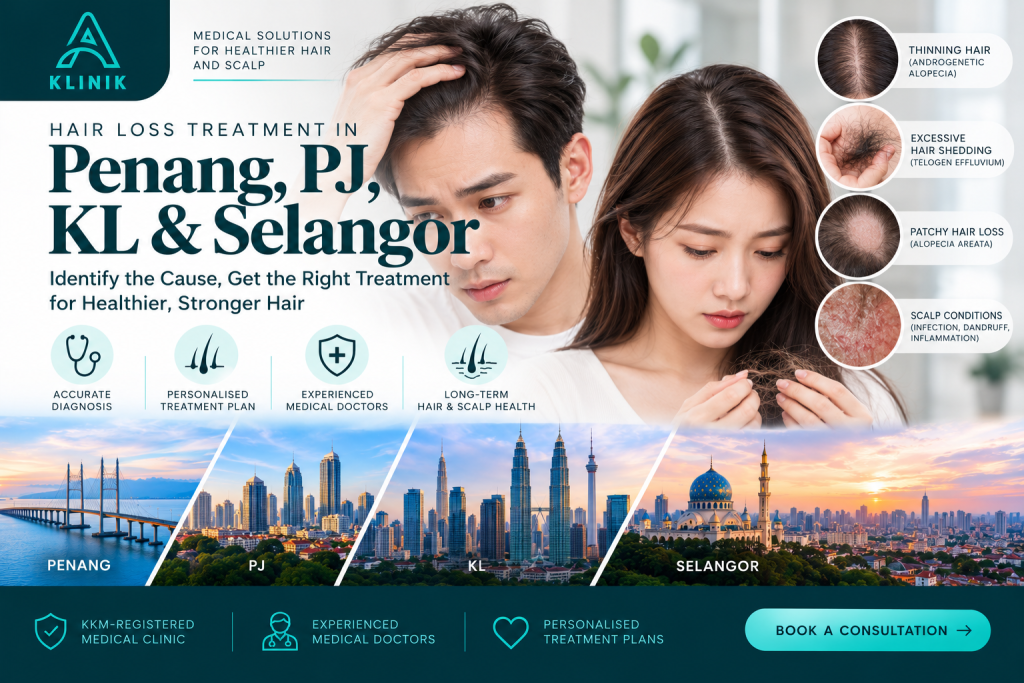


Hair Loss Treatment in Penang, PJ, KL & Selangor: Causes, Types & When to See a Doctor
Hair Loss Is Not Always Just About Ageing
Finding more hair than usual on your pillow, bathroom floor or shower drain can be worrying.
For some people, hair loss develops gradually. The hairline may slowly recede, the crown may become thinner, or the hair part may appear wider.
For others, hair shedding seems to begin suddenly.
Although some degree of daily hair shedding is normal, persistent or progressive hair loss may indicate an underlying condition that should be assessed.
According to the American Academy of Dermatology, people normally shed approximately 50 to 100 hairs per day as part of the natural hair-growth cycle. Excessive shedding or visible thinning, however, may have many different causes. American Academy of Dermatology
This is why choosing hair loss treatment should begin by asking:
“Why is the hair falling out?”
Hair loss can be associated with hereditary factors, ageing, hormonal changes, significant physical or emotional stress, certain illnesses, scalp infections, nutritional deficiencies, medications, autoimmune conditions and damaging hair practices.
For patients searching for hair loss treatment in Penang, PJ, KL & Selangor, identifying the possible cause is therefore an important first step before choosing medication, supplements, shampoos or other treatments.
At A Klinik Medical, our doctors assess the patient’s hair-loss pattern, scalp condition, medical history, symptoms and possible contributing factors before recommending an appropriate management plan.
What Is Hair Loss?
The medical term for hair loss is alopecia.
Hair loss can occur in many different patterns.
It may appear as:
- Gradual thinning
- A widening hair part
- Receding hairline
- Thinning at the crown
- Increased hair shedding
- Circular bald patches
- General reduction in hair density
- Hair loss associated with scalp inflammation
The pattern itself can provide useful clues about the possible cause.
For example, hereditary hair loss often develops gradually, while certain forms of excessive shedding may occur several months after a major illness, surgery, childbirth or stressful event.
This is why two patients searching for hair loss treatment may require completely different management plans.
Hair Loss vs Hair Shedding: What’s the Difference?
This is an important distinction.
Many patients say:
“I’m losing a lot of hair.”
But medically, excessive hair shedding and progressive hair loss are not necessarily the same thing.
Excessive Hair Shedding
Excessive shedding may occur after the body experiences a significant stressor.
Examples include:
- Major illness
- High fever
- Surgery
- Childbirth
- Significant psychological stress
- Major weight loss
One common form of excessive shedding is known as telogen effluvium.
The shedding often begins several months after the triggering event rather than immediately. In many cases, once the trigger has resolved, excessive shedding can gradually improve.
Progressive Hair Loss
Other forms of hair loss occur because the hair-growth process itself is being affected.
For example, hereditary hair loss may gradually cause follicles to shrink, leading to progressively thinner hair.
This distinction matters when choosing hair loss treatment in Penang, PJ, KL & Selangor because treating temporary shedding is different from managing progressive hereditary hair loss.
What Causes Hair Loss?
There is no single cause of hair loss.
This is one reason buying a “hair growth” product without understanding the underlying condition may not produce the expected result.
Genetics and Hereditary Hair Loss
One of the most common causes is androgenetic alopecia, also known as hereditary or pattern hair loss.
It can affect both men and women.
Male Pattern Hair Loss
Men may notice:
- Receding hairline
- Thinning temples
- Thinning crown
- Progressive reduction in hair density
Female Pattern Hair Loss
Women may notice:
- Widening hair part
- Reduced density
- Thinner ponytail
- Gradual thinning across the scalp
Hereditary hair loss is one of the most common causes of hair loss. Recognising the pattern earlier can be important because different types of hair loss require different management approaches. American Academy of Dermatology
For patients considering hair loss treatment in Penang, PJ, KL & Selangor, the first step should therefore be identifying the type and possible cause of hair loss.
Telogen Effluvium
Telogen effluvium is a form of excessive hair shedding that can occur after significant physical or emotional stress.
Potential triggers include:
- Illness
- High fever
- Surgery
- Childbirth
- Significant weight loss
- Major stress
- Certain medication or hormonal changes
Interestingly, the shedding may not happen immediately.
A patient may recover from an illness and only notice excessive shedding several months later.
This delayed reaction can make the cause difficult to recognise.
In many cases, hair density may gradually recover after the underlying trigger has resolved, although persistent or severe shedding should be medically assessed.
Alopecia Areata
Alopecia areata is an autoimmune condition in which the immune system attacks hair follicles.
It may cause sudden, clearly defined areas of hair loss.
Some patients develop one or several round bald patches, while more extensive hair loss can occur in other cases.
Alopecia areata can affect more than the scalp and may sometimes involve eyebrows, eyelashes or other body hair.
Because patchy hair loss can have different causes, patients should avoid assuming that every bald patch is hereditary hair loss.
Professional assessment is recommended.
Hormonal and Medical Factors
Certain medical or hormonal conditions can contribute to hair thinning.
These may include thyroid disorders and hormonal imbalances. Nutritional deficiencies involving nutrients such as iron, protein or zinc can also contribute in some patients.
This does not mean everyone experiencing hair loss should automatically take supplements.
Taking unnecessary supplements is not always harmless. Excessive intake of certain nutrients may be associated with worsening hair loss, which is why supplementation should ideally address an identified need rather than being used automatically. American Academy of Dermatology
This is another reason proper assessment is important before beginning hair loss treatment.
Scalp Conditions and Infections
Healthy hair also depends on a healthy scalp environment.
Certain scalp infections and inflammatory conditions can contribute to hair loss.
Patients may experience symptoms such as:
- Scalp itching
- Scaling
- Redness
- Tenderness
- Dandruff-like flakes
- Broken hairs
- Bald patches
A fungal scalp infection, for example, can cause areas of scaling and hair loss and requires appropriate medical treatment.
For patients searching for scalp treatment and hair loss treatment in Penang, PJ, KL & Selangor, examining the scalp is therefore an important part of the assessment.
Hair Styling and Hair Damage
Not every case of thinning begins inside the body.
Repeated tension on the hair can contribute to traction alopecia.
This may occur when hairstyles repeatedly pull tightly on the hair follicles.
Chemical treatments, excessive heat and damaging hair-care practices may also contribute to hair breakage and damage.
Changing these practices early may help prevent further damage. Repeated tension from tight hairstyles can lead to traction alopecia and, in more advanced cases, permanent hair loss. American Academy of Dermatology
What Are the Early Signs of Hair Loss?
Hair loss does not always begin with obvious baldness.
Early changes may be subtle.
Watch for signs such as:
- A widening hair part
- Thinner ponytail
- Receding hairline
- Thinning temples
- Increasingly visible scalp
- Thinning around the crown
- More hair than usual during washing
- Excessive hair on the pillow
- Circular bald patches
- Persistent reduction in hair density
If these changes continue progressing, seeking assessment earlier may help determine the cause before further hair is lost.
How Is Hair Loss Diagnosed?
Effective hair loss treatment starts with diagnosis.
During a medical assessment, your doctor may review:
- When the hair loss started
- Whether it began suddenly or gradually
- Pattern of thinning
- Family history
- Recent illnesses
- Major stress
- Recent childbirth
- Weight changes
- Medications
- Diet and nutritional history
- Hair-care practices
- Scalp symptoms
The hair and scalp may also be physically examined.
Depending on the suspected cause, further investigations such as blood tests may sometimes be appropriate. In selected cases, additional scalp assessment may also be needed.
This is why hair loss treatment in Penang, PJ, KL & Selangor should ideally begin with identifying the underlying problem rather than immediately choosing a treatment package.
Why Early Hair Loss Assessment Matters
Some forms of hair loss are temporary.
Others may progressively worsen.
Certain inflammatory or scarring forms of hair loss can permanently damage follicles if they are not identified early.
Therefore, early assessment may help determine:
Is this temporary shedding?
Is this hereditary hair loss?
Is there a scalp problem?
Could there be an underlying medical factor?
Is treatment required, or is observation appropriate?
Those questions are much more useful than simply asking:
“What is the best hair loss treatment?”
There is no single best treatment for every type of hair loss. The appropriate treatment depends on the cause.
Hair Loss Treatment Options
The most appropriate hair loss treatment depends on the underlying cause.
A patient experiencing hereditary hair thinning may require a very different treatment approach from someone experiencing temporary excessive shedding, alopecia areata, scalp infection or hair loss related to an underlying medical condition.
For patients searching for hair loss treatment in Penang, PJ, KL & Selangor, a proper medical assessment can help determine whether treatment is necessary and which approach may be appropriate.
Depending on the diagnosis, a management plan may include:
- Medical treatment
- Topical medication
- Oral medication where appropriate
- Treatment of underlying scalp conditions
- Correction of identified nutritional deficiencies
- Changes in damaging hair-care practices
- Lifestyle recommendations
- Monitoring and follow-up
There is therefore no single hair loss treatment that works for every patient. This diagnosis-first approach is also consistent with current AAD patient guidance on hair loss management. American Academy of Dermatology
Medical Treatment for Hair Loss
Certain types of hair loss can be treated or managed medically.
The treatment selected depends on factors such as:
- Type of hair loss
- Patient’s age
- Sex
- Severity
- Pattern of thinning
- Medical history
- Current medications
- Pregnancy considerations
- Underlying health conditions
Some treatments aim to slow further hair loss, while others may support hair regrowth in suitable patients.
However, results are not immediate.
Hair grows slowly, which means most hair loss treatment plans require consistency and time before meaningful changes can be evaluated.
Patients should also understand that medications used for one type of hair loss may not be suitable for another.
Male Pattern Hair Loss
Male pattern hair loss, or male androgenetic alopecia, is a common form of hereditary hair loss.
It often begins with:
- Receding temples
- A changing hairline
- Thinning at the crown
- Progressive reduction in hair density
Some men begin noticing these changes relatively early in adulthood.
Because hereditary hair loss can progress over time, patients seeking hair loss treatment in Penang, PJ, KL & Selangor may benefit from assessment before extensive thinning develops.
Depending on the diagnosis and individual suitability, medical management may be considered to help slow further progression and potentially improve hair growth.
The appropriate treatment should be determined by a doctor after reviewing the patient’s health and hair-loss pattern.
Female Pattern Hair Loss
Women can also experience hereditary hair loss.
Female pattern hair loss may look different from the typical pattern seen in men.
Common signs include:
- Widening of the hair part
- Reduced density over the top of the scalp
- Increasingly visible scalp
- Thinner ponytail
- Gradual reduction in overall hair volume
However, female hair loss may also be associated with other factors, including hormonal changes, nutritional deficiencies, thyroid conditions, illness, childbirth, medications and stress.
For this reason, female hair loss treatment should not automatically begin with a hair-growth product.
A proper assessment can help identify whether the thinning is hereditary or related to another contributing factor.
Telogen Effluvium Treatment
When excessive hair shedding is caused by telogen effluvium, treatment is often focused on identifying and addressing the underlying trigger.
Potential triggers can include:
- Significant illness
- High fever
- Surgery
- Childbirth
- Major psychological stress
- Significant weight loss
- Nutritional deficiency
- Certain medications
In many cases, shedding may gradually improve once the underlying trigger has resolved.
However, recovery takes time because hair follows a natural growth cycle.
If excessive shedding continues for an extended period, medical assessment may help determine whether another condition is contributing to the problem.
Alopecia Areata Treatment
Alopecia areata is an autoimmune condition that may cause sudden patches of hair loss.
Treatment depends on factors such as:
- Patient’s age
- Number of affected areas
- Extent of hair loss
- Duration
- Previous episodes
- Overall health
Because sudden patchy hair loss can have several possible causes, patients should seek a medical diagnosis rather than assuming the condition is ordinary hereditary thinning.
Treatment also varies according to the patient’s age, extent and duration of hair loss, and other individual considerations. American Academy of Dermatology
Treating Scalp Conditions That Contribute to Hair Loss
Sometimes the scalp itself is part of the problem.
Patients may experience hair concerns together with:
- Persistent dandruff
- Severe itching
- Scaling
- Redness
- Inflammation
- Pain
- Crusting
- Fungal infection
In these cases, appropriate scalp treatment may be an important part of the overall hair loss treatment plan.
For example, treating a fungal scalp infection requires a different approach from treating hereditary hair loss.
Patients looking for scalp treatment in Penang, PJ, KL & Selangor should therefore receive an assessment to identify the underlying scalp condition.
Can Hair Grow Back After Hair Loss?
This is probably one of the most important questions patients ask:
“Will my hair grow back?”
The answer depends on the cause.
Some types of hair loss can improve substantially when the underlying trigger is removed.
For example, temporary excessive shedding following illness or significant stress may gradually improve as the normal hair-growth cycle recovers.
Other forms of hair loss, such as hereditary pattern hair loss, tend to progress over time and may require ongoing management.
Hair loss that permanently damages or scars the hair follicle can be more difficult to reverse.
This is why early diagnosis matters.
Rather than promising that every hair loss treatment will regrow hair, the first goal should be to understand whether the follicles are still capable of producing healthy hair.
Do Hair Growth Shampoos Really Work?
Patients searching for hair loss treatment frequently encounter shampoos claiming to stop hair loss or stimulate dramatic regrowth.
The reality is more complicated.
Shampoo can be useful for maintaining scalp cleanliness and may help manage certain scalp conditions.
However, shampoo alone generally cannot correct every underlying cause of hair loss.
For example, shampoo cannot independently correct:
- Hereditary hair loss
- Autoimmune alopecia
- Significant iron deficiency
- Thyroid-related hair loss
- Hormonal conditions
- Scarring alopecia
A shampoo may form part of a broader scalp-care routine, but it should not replace proper diagnosis when hair loss is persistent or progressive.
Do Hair Loss Supplements Work?
Another common question is whether vitamins and supplements can stop hair loss.
Supplements can be useful when a person has a confirmed nutritional deficiency contributing to hair loss.
However, taking supplements without knowing whether a deficiency exists is not necessarily beneficial.
Hair health can be affected by deficiencies involving nutrients such as iron, protein, zinc and certain vitamins, but excessive supplementation is not automatically better.
Therefore, patients seeking hair loss treatment in Penang, PJ, KL & Selangor should avoid assuming that every hair-loss problem is caused by vitamin deficiency.
If a nutritional problem is suspected, appropriate medical assessment and testing may be considered.
What About Hair Tonics and Hair Growth Serums?
Hair tonics, scalp serums and cosmetic hair-growth products are heavily marketed.
Some products may help improve scalp condition or the cosmetic appearance of hair.
However, their effectiveness depends on:
- Active ingredients
- Concentration
- Underlying cause of hair loss
- Quality of evidence
- Consistency of use
A product that appears helpful for one person may not address another person’s underlying condition.
This is why diagnosis remains the foundation of appropriate hair loss treatment.
How Long Does Hair Loss Treatment Take?
Hair growth is slow.
Therefore, hair loss treatment generally requires patience.
You should not expect significant changes after only a few days or weeks.
Depending on the underlying condition and treatment selected, it may take several months before meaningful changes can be assessed.
Your doctor may monitor:
- Hair shedding
- Hair density
- Progression of thinning
- Scalp condition
- Treatment tolerance
- New hair growth
Photographs taken under similar lighting and positioning can also be useful for monitoring progress over time.
Importantly, results vary between patients.
No responsible clinic should guarantee a specific amount of hair regrowth for every individual.
Why Does My Hair Loss Treatment Seem to Stop Working?
Sometimes patients initially notice improvement but later feel that progress has slowed.
Possible explanations include:
- The underlying condition is progressive
- Treatment has been used inconsistently
- The original trigger remains present
- Another condition has developed
- Expectations are unrealistic
- Treatment needs adjustment
Some types of hereditary hair loss require ongoing management to maintain benefits.
Stopping treatment may allow the underlying hair-loss process to continue.
Regular follow-up allows the treatment plan to be reviewed and adjusted where appropriate.
Hair Loss Treatment in Penang
Patients searching for hair loss treatment Penang may be experiencing anything from gradual hereditary thinning to sudden excessive shedding or scalp-related hair loss.
At A Klinik Medical, patients seeking hair loss treatment in Penang can receive medical assessment to help determine the possible underlying cause.
Patients looking for a hair loss clinic or medical assessment for hair and scalp concerns can access A Klinik Medical through our Penang locations:
Jelutong
Medical consultation for hair, scalp, skin and general health concerns.
Bayan Lepas
Convenient access for patients seeking medical assessment and hair loss treatment in Penang.
Raja Uda
Medical consultation for patients experiencing hair thinning, scalp concerns and other health conditions.
Relau
Medical assessment and personalised management for hair, scalp and skin concerns.
Having multiple locations can also make follow-up more convenient when ongoing monitoring is required.
Hair Loss Treatment in PJ
Patients searching for hair loss treatment in PJ or Petaling Jaya may be experiencing progressive thinning, excessive shedding, a widening hair part, receding hairline or scalp-related concerns.
Because different forms of hair loss can look similar during the early stages, treatment should ideally begin by identifying the possible underlying cause.
Patients in PJ can consider medical assessment through A Klinik Medical’s wider Klang Valley network.
Depending on the individual’s symptoms and history, assessment may consider hereditary factors, scalp health, recent illness, stress, medications, nutrition and other possible contributors.
Hair Loss Treatment in KL
Patients searching for hair loss treatment KL may be concerned about progressive thinning, excessive shedding, receding hairlines or scalp problems.
Patients may have:
- Male pattern hair loss
- Female pattern hair loss
- Telogen effluvium
- Alopecia areata
- Scalp conditions
- Other medical causes of hair loss
Patients looking for a hair loss clinic or medical assessment in Kuala Lumpur can seek consultation at our:
Cheras
Our doctors can assess the pattern and possible contributing factors before recommending an appropriate hair loss management plan.
Rather than simply choosing a hair-growth package, patients can receive medical guidance based on their individual condition.
Hair Loss Treatment in Selangor
For patients searching for hair loss treatment Selangor, A Klinik Medical provides access through several locations.
Puchong
Patients experiencing excessive shedding, thinning or scalp concerns can receive medical assessment before treatment planning.
Klang
Our doctors assess possible causes of hair loss and recommend management according to the patient’s individual condition.
Gombak
Patients looking for medical assessment for hair thinning, excessive shedding and associated scalp concerns can seek consultation at our Gombak location.
Whether you’re searching for hair loss treatment in Selangor due to progressive thinning or sudden shedding, identifying the cause remains the first step.
When Should You See a Doctor for Hair Loss?
Consider seeking medical assessment if:
- Hair loss begins suddenly
- You develop circular bald patches
- Your hairline is progressively receding
- Your hair part is becoming wider
- Your scalp is increasingly visible
- Hair shedding continues for several months
- You experience scalp pain or significant itching
- Your scalp becomes red or inflamed
- Hair loss occurs together with other unexplained symptoms
- Hair loss begins after starting medication
- Over-the-counter products are not helping
- Hair loss is affecting your confidence or daily life
You should also seek assessment if you are simply uncertain about what type of hair loss you have.
The earlier the underlying cause is identified, the earlier an appropriate hair loss treatment strategy can be considered.
What Makes a Good Hair Loss Treatment Plan?
A good hair loss treatment plan should not begin with:
“Which package would you like?”
It should begin with:
“What is causing the hair loss?”
A proper plan may involve:
Diagnosis → identify contributing factors → treat the underlying condition → monitor hair and scalp → adjust treatment when necessary.
That is especially important for patients searching for hair loss treatment in Penang, PJ, KL & Selangor.
The target should not simply be “more hair.”
The target should be appropriate medical management of the condition responsible for the hair loss.
Why Choose A Klinik Medical for Hair Loss Treatment in Penang, PJ, KL & Selangor?
Choosing a clinic for hair loss treatment in Penang, PJ, KL & Selangor should begin with one important question:
“What is causing the hair loss?”
Hair loss can develop for many different reasons. Hereditary hair loss, excessive shedding, scalp conditions, autoimmune disorders, nutritional deficiencies, hormonal factors, certain medications and medical conditions may all contribute to changes in hair density.
Because the underlying causes differ, the appropriate hair loss treatment can also differ significantly from one patient to another.
At A Klinik Medical, our approach begins with a medical consultation and assessment rather than assuming that every patient requires the same hair-growth treatment.
Our doctors may assess:
- Hair-loss pattern
- Degree of hair thinning
- Hair shedding
- Scalp condition
- Family history
- Medical history
- Current medications
- Previous treatments
- Recent illness or surgery
- Significant stress
- Diet and nutritional factors
- Hair-care practices
- Other relevant symptoms
Where appropriate, further investigation may be considered based on the patient’s history and clinical findings.
The aim is to understand the possible underlying cause before developing an individualised hair loss treatment plan.
Medical Assessment Before Hair Loss Treatment
Hair loss treatments are widely advertised online, but a product being marketed for “hair growth” does not mean it is appropriate for every type of hair loss.
For example, a patient experiencing hereditary pattern hair loss has different needs from someone experiencing temporary shedding following an illness.
Similarly, a patient with scalp inflammation or fungal infection requires a different approach from someone with alopecia areata.
This is why patients seeking hair loss treatment in Penang, PJ, KL & Selangor should consider medical assessment before committing to a long-term treatment programme.
At A Klinik Medical, treatment recommendations are based on the patient’s individual condition rather than a one-size-fits-all approach.
Personalised Hair Loss Treatment Plans
Every patient’s hair and scalp condition is different.
A personalised hair loss treatment plan may take into account:
- Diagnosis
- Age
- Sex
- Severity of hair loss
- Duration
- Hair-loss pattern
- Scalp health
- Medical conditions
- Current medication
- Lifestyle
- Previous treatments
- Treatment goals
Depending on the diagnosis, management may involve medical treatment, scalp management, lifestyle advice, correction of an identified deficiency or monitoring over time.
Some conditions may also require referral or additional investigation where appropriate.
Most importantly, patients should receive realistic expectations.
Not every type of hair loss can be completely reversed, and no responsible medical provider should guarantee that every patient will achieve full hair regrowth.
Why Patients Choose A Klinik Medical
A Klinik Medical focuses on providing accessible primary healthcare together with medical skin, scalp and hair assessment.
The supplied clinic material highlights:
- Experienced medical doctors
- KKM-registered medical clinics
- Medical assessment before treatment
- Evidence-based care
- Personalised treatment plans
- Patient education
- Honest consultation
- Appropriate follow-up
- Long-term health management
Rather than simply focusing on the visible symptom of thinning hair, the approach described in the original article aims to identify possible contributing factors and determine the appropriate next step. Pasted markdown
Supporting Healthy Hair Beyond Treatment
Medical treatment is only one part of maintaining healthy hair.
Depending on the underlying cause, your doctor may also discuss everyday factors that affect hair and scalp health.
Eat a Balanced Diet
Hair growth requires adequate nutrition.
A balanced diet containing sufficient protein, vitamins and minerals supports normal body functions, including hair growth.
However, patients should avoid assuming that more supplements automatically mean more hair growth.
Supplements are most appropriate when there is an identified need.
Avoid Extremely Restrictive Diets
Rapid weight loss and significant dietary restriction may contribute to excessive hair shedding in some individuals.
If hair shedding begins following major weight loss or dietary changes, mention this during your consultation.
Be Gentle with Your Hair
Excessive pulling, heat or chemical processing can contribute to hair damage.
Consider reducing:
- Very tight hairstyles
- Frequent high-heat styling
- Excessive chemical processing
- Aggressive brushing
- Repeated pulling on the hair
Protecting existing hair is an important part of long-term hair care.
Take Care of Your Scalp
Healthy-looking hair begins with an appropriately cared-for scalp.
Persistent:
- Itching
- Redness
- Scaling
- Pain
- Crusting
- Severe dandruff
should not simply be ignored.
If a scalp condition is contributing to hair loss, appropriate scalp treatment may form part of the overall management plan.
When Is Hair Loss a Warning Sign?
Some degree of daily shedding is normal.
However, consider seeing a doctor when hair loss is:
- Sudden
- Severe
- Progressively worsening
- Occurring in circular patches
- Associated with scalp inflammation
- Associated with pain
- Accompanied by significant scaling
- Associated with other unexplained symptoms
- Continuing for several months
- Affecting your quality of life
A sudden change in hair density may sometimes provide information about what is happening elsewhere in the body.
Medical assessment can help determine whether additional investigation is necessary.
Can Hair Loss Be Prevented?
Not every type of hair loss can be prevented.
Hereditary hair loss, for example, is influenced by genetic factors.
However, some causes of hair damage or shedding may be reduced by:
- Avoiding excessive tension on the hair
- Maintaining adequate nutrition
- Avoiding unnecessary crash diets
- Managing scalp conditions
- Seeking medical care for persistent symptoms
- Using hair-care products appropriately
- Avoiding unnecessary supplementation
- Following prescribed treatment consistently
For progressive forms of hair loss, early recognition may allow management to begin sooner.
Is Hair Loss Treatment Permanent?
This depends entirely on the underlying condition.
Some temporary forms of shedding may resolve after the triggering factor has been corrected.
Other conditions, particularly hereditary pattern hair loss, may require ongoing management.
If treatment is discontinued, the underlying hair-loss process may continue.
This is why patients considering hair loss treatment in Penang, PJ, KL & Selangor should discuss both short-term expectations and long-term management with their doctor.
A good treatment plan should explain not only what may improve, but also what may happen if treatment is discontinued.
Conclusion
Hair loss is common, but the reason behind it can vary considerably from one person to another.
Hereditary pattern hair loss, telogen effluvium, alopecia areata, scalp conditions, nutritional deficiencies, hormonal factors, medical conditions, medications and damaging hair practices can all contribute to hair thinning or excessive shedding.
For this reason, successful hair loss treatment begins with identifying the possible underlying cause.
Patients should be cautious about assuming that a particular shampoo, supplement, serum or commercial treatment will work for every type of hair loss.
If you’re searching for hair loss treatment in Penang, PJ, KL & Selangor, particularly because your hair loss is sudden, progressive, patchy or persistent, a medical consultation can help determine the appropriate next step.
At A Klinik Medical, our doctors provide individualised assessment and management for patients experiencing hair thinning, excessive shedding and associated scalp concerns.
Our focus is on appropriate diagnosis, personalised medical care, realistic expectations and long-term hair and scalp health.
Frequently Asked Questions
1. What is the best treatment for hair loss?
There is no single best hair loss treatment for everyone.
Treatment depends on the underlying cause. Hereditary hair loss, telogen effluvium, alopecia areata, nutritional deficiency and scalp-related hair loss may all require different management approaches.
A medical assessment can help determine the type of hair loss before treatment is recommended.
2. Can thinning hair grow back?
It depends on why the hair is thinning.
Some temporary forms of excessive shedding may improve after the underlying trigger resolves. Other forms, such as hereditary hair loss, may require ongoing treatment to slow progression or support regrowth.
Hair loss involving permanent follicle damage may be more difficult to reverse.
3. How long does hair loss treatment take to work?
Hair grows slowly, so hair loss treatment usually requires patience.
Depending on the condition and treatment selected, several months may be needed before meaningful changes can be assessed.
Results vary between patients, and treatment should be reviewed periodically.
4. Why am I suddenly losing so much hair?
Sudden excessive shedding may occur after significant illness, fever, surgery, childbirth, major stress, rapid weight loss or other physical changes.
However, there are many possible causes.
If excessive shedding continues, medical assessment can help determine whether the hair loss is temporary or associated with another condition.
5. Where can I get hair loss treatment in Penang, PJ, KL & Selangor?
Patients seeking hair loss treatment in Penang, PJ, KL & Selangor can consult A Klinik Medical for medical assessment of hair thinning, excessive shedding and associated scalp concerns.
A Klinik Medical has locations in Jelutong, Bayan Lepas, Raja Uda and Relau in Penang, as well as Cheras, Puchong, Klang and Gombak across the Klang Valley.
Patients in PJ can consider A Klinik Medical’s wider Klang Valley network for medical assessment.
Medically Reviewed By Dr. Aaron Low