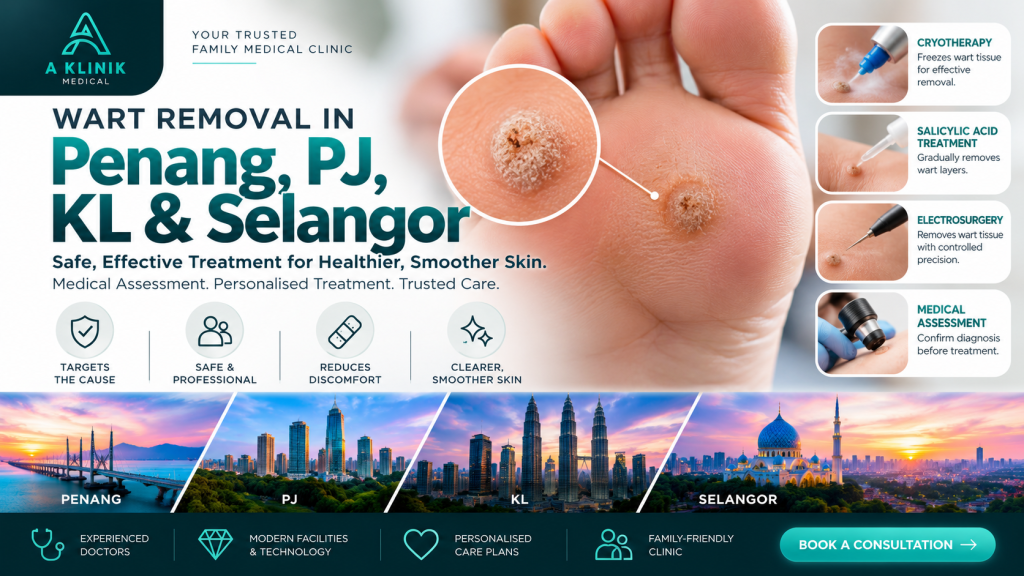


Wart Removal in Penang, PJ, KL & Selangor: Causes, Treatment Options & When to See a Doctor
Warts are common skin growths that can appear almost anywhere on the body.
You may notice a small rough bump on your finger, a hard growth on the sole of your foot, several flat bumps on your face, or a wart that seems to disappear and then return again.
One of the most common questions patients ask is:
“Why do I keep getting warts?”
Warts are usually caused by infection with certain types of human papillomavirus (HPV). The virus can enter the skin through small breaks and cause the skin cells in the affected area to grow differently, resulting in a wart.
Although many warts are harmless and some may eventually disappear without treatment, others can persist, spread, become uncomfortable or cause cosmetic concerns.
For patients searching for wart removal in Penang, PJ, KL & Selangor, the first step should be confirming that the growth is actually a wart.
Not every bump on the skin is a wart.
Skin tags, corns, calluses and other skin lesions can sometimes be mistaken for warts, and their management may be different.
At A Klinik Medical, our doctors assess the skin lesion, its location, appearance and symptoms before recommending an appropriate management or wart removal treatment.
What Is a Wart?
A wart is a non-cancerous skin growth caused by infection with certain types of HPV.
There are many different types of HPV, and different types can affect different areas of the skin.
Warts may appear:
- Rough
- Raised
- Flat
- Grainy
- Hard
- Skin-coloured
- Greyish or brownish
- As a single growth
- In groups or clusters
Some warts may contain tiny dark dots.
These are often small, clotted blood vessels within the wart rather than “roots.”
Warts can occur at almost any age, although they are particularly common in children and younger people.
What Causes Warts?
Warts develop after HPV infects the outer layers of the skin.
The virus can enter through small breaks or damaged areas of skin.
This means the risk of developing or spreading warts may increase when the skin is repeatedly:
- Cut
- Scratched
- Picked
- Shaved
- Bitten around the nails
- Exposed to an existing wart
However, exposure to HPV does not mean that everyone will develop a wart.
Individual immune responses vary, which is one reason some people seem more prone to warts than others.
Are Warts Contagious?
Yes. Warts can spread from one person to another because they are caused by a virus.
Transmission can occur through direct skin-to-skin contact or, less commonly, through contaminated surfaces or objects.
Warts can also spread from one part of your own body to another.
For example, repeatedly picking a wart and then touching damaged skin elsewhere may contribute to spreading the virus.
This is known as autoinoculation.
To reduce the chance of spreading warts, it is generally sensible to:
- Avoid picking or scratching them
- Wash your hands after touching a wart
- Avoid sharing personal items that contact the affected area
- Avoid biting nails when warts are around the fingers
- Keep cuts and damaged skin appropriately protected
Seeking wart removal does not necessarily mean the virus can never recur, so prevention remains useful even after treatment.
What Are the Different Types of Warts?
Not every wart looks the same.
The appearance can depend on the type of wart and where it develops.
1. Common Warts
Common warts, also known as verruca vulgaris, often develop on the:
- Fingers
- Hands
- Around the nails
- Knees
- Other areas exposed to minor skin trauma
They commonly appear as rough, raised growths.
Some people describe the surface as looking slightly like a cauliflower.
Common warts may occur alone or in groups.
2. Plantar Warts
Plantar warts develop on the soles of the feet.
Because you place pressure on the area when standing and walking, these warts may grow inward beneath a layer of harder skin.
Patients sometimes mistake plantar warts for corns or calluses.
Symptoms can include:
- A rough growth on the sole
- Hard skin over the area
- Small dark dots
- Pain or tenderness when walking
- Discomfort when pressure is applied
For patients looking for wart removal in Penang, PJ, KL & Selangor, distinguishing a plantar wart from a corn is important because they have different causes and management.
3. Flat Warts
Flat warts tend to be smaller and smoother than common warts.
They may appear in larger numbers and can develop on areas such as the:
- Face
- Forehead
- Hands
- Legs
Because they are flatter and less rough, patients may initially think they are acne, small bumps or another skin condition.
Flat warts may also spread along areas affected by shaving or repeated minor trauma.
4. Filiform Warts
Filiform warts have a different appearance.
They may develop as narrow or finger-like projections and commonly occur around areas such as the:
- Face
- Eyelids
- Nose
- Mouth
- Neck
Because these areas are more delicate, patients should be especially careful about attempting DIY wart removal.
Treatment around the eyes and other sensitive areas requires appropriate assessment.
Wart vs Skin Tag: What’s the Difference?
This is one of the most common areas of confusion.
Patients sometimes come to the clinic saying:
“I have many warts on my neck.”
But some of those growths may actually be skin tags.
Warts
Warts are caused by HPV and can be contagious.
They may have a rough or irregular surface depending on the type.
Skin Tags
Skin tags are soft, benign skin growths that commonly appear in areas where skin rubs against skin or clothing.
Common locations include:
- Neck
- Armpits
- Groin
- Under the breasts
- Other skin folds
Skin tags are not caused by the same viral infection that causes common skin warts.
This distinction matters because wart removal and skin tag removal are not necessarily approached in exactly the same way.
If you’re unsure whether a growth is a wart or skin tag, medical assessment can help clarify the diagnosis.
Wart vs Corn: How Can You Tell?
This is particularly important for growths on the feet.
A corn develops because of repeated pressure or friction.
A plantar wart is caused by HPV.
Both can produce an area of thickened skin and may become painful when walking.
Some plantar warts contain tiny dark dots representing thrombosed capillaries.
However, self-diagnosis based on one sign alone is not always reliable.
If a persistent painful growth develops on the sole of your foot, a doctor can examine the lesion before recommending treatment.
Wart vs Callus
Calluses are areas of thickened skin caused by repeated friction or pressure.
They commonly develop on:
- Feet
- Toes
- Hands
- Areas exposed to repeated mechanical pressure
Unlike warts, calluses are not caused by HPV and are not contagious.
Removing a callus without addressing the underlying pressure or friction may allow it to return.
Again, this highlights an important principle:
Correct diagnosis comes before removal.
Can Warts Go Away on Their Own?
Yes, some warts can eventually disappear without treatment as the immune system responds to the viral infection.
However, this can take time.
Some warts may persist for months or longer, and the course varies considerably between individuals.
During that time, a wart may:
- Remain unchanged
- Increase in size
- Spread
- Develop additional nearby warts
- Become irritated
- Become painful depending on location
Therefore, whether to observe or consider wart removal treatment depends on the individual situation.
When Should You Consider Wart Removal?
Not every wart needs to be removed immediately.
However, you may consider seeking medical assessment when:
- The wart is painful
- It bleeds repeatedly
- It becomes irritated
- It interferes with walking
- It catches on clothing
- It is spreading
- Multiple new warts appear
- It is located on the face
- It is around the nails
- It persists for a long time
- It causes significant cosmetic concern
- You are unsure whether it is actually a wart
Patients looking for wart removal in Penang, PJ, KL & Selangor should ideally have uncertain skin growths assessed before attempting removal.
Why Does My Wart Keep Coming Back?
This is probably one of the most frustrating things about warts.
You remove it.
It disappears.
Then some time later…
It’s back.
Warts are caused by a viral infection, so removing the visible growth does not always guarantee that recurrence will never happen.
Treatment response can also vary according to:
- Wart type
- Location
- Size
- Number of warts
- Duration
- Treatment used
- Individual immune response
Some warts require repeated treatment.
Others may respond more easily.
This is why patients should be cautious of advertisements promising:
“One session = permanent wart removal.”
No responsible wart removal treatment should guarantee that a wart can never recur.
Should You Cut a Wart Off Yourself?
No.
Cutting, burning or aggressively removing a suspected wart at home can cause:
- Bleeding
- Pain
- Infection
- Skin injury
- Scarring
- Pigmentation
- Spread of the virus
There is another important issue:
What if it isn’t actually a wart?
Not every skin growth should be destroyed without a diagnosis.
If a lesion looks unusual or its diagnosis is uncertain, medical assessment is more appropriate than DIY removal.
What About Wart Removal Products From the Pharmacy?
Some over-the-counter wart treatments contain ingredients such as salicylic acid and may be appropriate for certain common or plantar warts when used correctly.
However, they are not suitable for every lesion or every body area.
Extra caution is needed when:
- The diagnosis is uncertain
- The lesion is on the face
- The lesion is near the eye
- The surrounding skin is damaged
- The patient has certain medical conditions affecting healing or sensation
- The lesion looks unusual
- Previous treatment has repeatedly failed
Products designed for ordinary hand or foot warts should not automatically be applied to sensitive areas.
Can I Remove Warts on My Face?
Facial warts require more careful assessment.
A growth on the face may be cosmetically bothersome, but the face is also an area where unnecessary skin injury, pigmentation changes or scarring may be particularly noticeable.
The type of wart also matters.
For patients seeking facial wart removal in Penang, PJ, KL & Selangor, a doctor can first determine whether the growth appears consistent with a wart and discuss suitable treatment options.
Avoid cutting, burning or using strong wart-removal chemicals on the face without appropriate medical advice.
Can Warts Spread After Shaving?
They can.
Shaving can create tiny injuries in the skin and may potentially spread HPV from an existing wart to nearby areas.
This is particularly relevant for flat warts.
If you notice multiple small bumps appearing along an area that is regularly shaved, avoid repeatedly shaving directly over suspected warts and consider medical assessment.
Are Warts Dangerous?
Most common skin warts are benign.
However, you should not assume that every new skin growth is a wart.
Seek medical assessment if a lesion:
- Changes rapidly
- Has an unusual appearance
- Repeatedly bleeds without obvious trauma
- Develops unusual pigmentation
- Becomes persistently ulcerated
- Is significantly painful
- Does not behave like a typical wart
- Has an uncertain diagnosis
The purpose isn’t to make every skin growth sound dangerous.
It’s simply important to diagnose before treating.
Do Genital Warts Use the Same Wart Removal Treatment?
Genital warts also involve HPV, but they are a different clinical situation from common warts on the hands, feet or face.
They should not simply be treated with ordinary over-the-counter wart-removal products intended for hands or feet.
If you suspect genital warts, seek appropriate medical assessment for diagnosis, treatment options and relevant sexual-health advice.
How Do Doctors Diagnose Warts?
In many cases, doctors can assess a suspected wart by examining its appearance and location.
The consultation may consider:
- How long the growth has been present
- Whether it is increasing in size
- Whether additional lesions have appeared
- Whether it is painful
- Whether it bleeds
- Previous treatment
- Whether similar lesions exist elsewhere
- The patient’s medical history
If the lesion does not have a typical appearance or the diagnosis is uncertain, further assessment may be required.
For patients considering wart removal, confirming what the lesion actually is should come before deciding how to remove it.
Why Medical Assessment Matters Before Wart Removal
A small bump may look simple.
But there are several possibilities:
Wart → viral skin growth
Skin tag → benign soft growth
Corn → pressure-related thickened skin
Callus → friction-related thickened skin
Another skin lesion → may require a different assessment
Therefore, the first question at A Klinik Medical isn’t simply:
“How do we remove it?”
It is:
“What exactly are we treating?”
Once the diagnosis is clearer, the doctor can discuss whether treatment is needed and which wart removal treatment may be appropriate.
For patients searching for wart removal in Penang, PJ, KL & Selangor, this medical-first approach helps avoid treating the wrong skin condition.
What Are the Treatment Options for Wart Removal?
Once a skin growth has been assessed and appears consistent with a wart, the next question is usually:
“How can I remove it?”
There are several approaches to wart removal, and the appropriate option depends on factors such as:
- Type of wart
- Size
- Location
- Number of warts
- How long the wart has been present
- Previous treatment
- Patient’s age
- Skin condition
- Individual medical history
Some warts may respond to topical treatment, while others may require procedures performed in a medical setting.
For patients searching for wart removal in Penang, PJ, KL & Selangor, it is important to understand that there is no single method that guarantees every wart will disappear permanently after one treatment.
1. Cryotherapy for Wart Removal
Cryotherapy is a commonly used medical treatment for certain types of warts.
It involves applying a very cold substance — commonly liquid nitrogen — to freeze the wart tissue.
The freezing process damages the treated tissue, after which the area gradually heals.
Cryotherapy may be considered for certain:
- Common warts
- Hand warts
- Foot warts
- Other suitable warts
The suitability depends on the location, size and characteristics of the lesion.
Does Cryotherapy Hurt?
Patients may experience a stinging, burning or painful sensation during and shortly after freezing.
The level of discomfort varies depending on:
- Treatment area
- Size of the wart
- Duration and intensity of freezing
- Individual pain sensitivity
After treatment, the area may become:
- Red
- Swollen
- Tender
- Blistered
These can occur as part of the expected local reaction to cryotherapy.
Your doctor should explain what to expect and how to care for the treated area.
Will One Cryotherapy Session Remove a Wart?
Not necessarily.
This is an important expectation to establish.
Some warts may require multiple cryotherapy sessions, often spaced apart to allow the skin to recover between treatments.
The number of sessions varies according to the wart and individual response.
For example, a small recent wart may respond differently from a thick plantar wart that has been present for years.
Therefore, patients considering wart removal treatment should avoid expecting that every wart will disappear after a single freezing session.
2. Salicylic Acid Treatment for Warts
Salicylic acid is another commonly used treatment for certain common and plantar warts.
It works by gradually removing layers of the affected skin.
Unlike a procedure performed in one clinic visit, salicylic acid treatment generally requires consistent application over time.
Depending on the product and wart location, patients may need to continue treatment for several weeks or longer.
Following instructions is important because applying the product incorrectly can irritate healthy surrounding skin.
Is Salicylic Acid Suitable for Every Wart?
No.
It should not automatically be used on every skin growth.
Particular caution is required for sensitive areas such as the:
- Face
- Around the eyes
- Genital area
- Damaged or infected skin
Patients with certain medical conditions may also require professional advice before using wart treatments on the feet or other areas.
Most importantly:
Do not apply wart-removal acid to a lesion if you’re not sure it is actually a wart.
3. Electrosurgery or Cautery for Wart Removal
Depending on the wart and clinical situation, procedures that use controlled electrical energy may sometimes be considered.
These techniques destroy or remove wart tissue using controlled heat or electrical energy.
They may be considered for selected lesions depending on:
- Size
- Location
- Wart type
- Previous treatment
- Doctor’s assessment
Because these procedures create a controlled wound, aftercare is important.
Patients should also understand that any procedure involving skin destruction can carry potential risks such as:
- Pain
- Bleeding
- Infection
- Pigmentation changes
- Scarring
The risks vary according to the procedure, location and individual patient.
4. Other Medical Wart Treatments
Not all warts respond to the same treatment.
For persistent or difficult warts, doctors may consider other treatment approaches depending on the clinical situation.
Some cases may also require referral for additional management.
The important point is that wart removal should be individualised.
A treatment that works well for a small wart on a finger may not necessarily be the preferred option for:
- Multiple flat warts on the face
- A thick plantar wart
- A wart around the nail
- Recurrent warts
- A lesion with an uncertain diagnosis
Wart Removal for Warts on the Hands
Hands and fingers are common locations for warts.
Because our hands frequently touch objects and other areas of the body, patients may also worry about spreading the virus.
Warts around the fingers can become particularly annoying if they:
- Catch on objects
- Bleed after trauma
- Interfere with daily activities
- Spread around the nails
- Increase in number
Treatment options depend on the individual wart.
Patients should avoid biting, cutting or repeatedly picking hand warts because trauma may contribute to irritation and potential spread.
Wart Removal Around the Nails
Warts that develop around or underneath the nails are known as periungual warts.
These can sometimes be more difficult to manage because of their location.
They may affect the skin surrounding the nail and, in some cases, interfere with normal nail growth.
Aggressive DIY treatment around the nail should be avoided because damaging the nail structures can create additional problems.
Medical assessment is particularly useful when a wart:
- Is close to the nail
- Is growing underneath the nail
- Keeps recurring
- Causes pain
- Affects nail appearance or growth
Plantar Wart Removal
Plantar warts occur on the soles of the feet.
Because body weight places pressure on them while walking, they may become painful and may appear flattened beneath thickened skin.
Treatment can sometimes be more challenging because plantar warts may be relatively thick.
Depending on the individual case, management may involve:
- Topical wart treatment
- Cryotherapy
- Other medical treatment
- Repeated treatment sessions
For patients searching for wart removal in Penang, PJ, KL & Selangor because of a painful growth on the foot, confirming whether the lesion is a plantar wart or a corn is an important first step.
Facial Wart Removal
Facial warts need particular care.
The face is cosmetically sensitive, and aggressive treatment may increase the risk of visible:
- Irritation
- Pigmentation changes
- Skin injury
- Scarring
The type of facial wart also matters.
Flat warts, for example, may occur in larger numbers and require a different strategy from a single common wart.
For facial wart removal, treatment should balance effectiveness with the risk of unnecessary damage to surrounding skin.
Can Laser Be Used for Wart Removal?
Certain laser treatments may be considered for selected resistant warts, particularly when other approaches have not been successful.
However:
Laser is not automatically the best wart removal treatment simply because it sounds more advanced.
The decision depends on factors such as:
- Wart type
- Location
- Size
- Number
- Previous treatment
- Available treatment options
Patients should not choose a wart treatment based only on which technology sounds strongest.
Which Wart Removal Treatment Is Best?
There is no single “best” method for everyone.
Consider three different patients.
Patient A
A small common wart on the finger.
Patient B
A thick, painful plantar wart that has been present for a long time.
Patient C
Multiple small flat warts on the face.
All three have warts.
But their treatment strategies may be different.
Therefore, the best wart removal treatment is the one selected according to the patient’s diagnosis, wart characteristics and individual circumstances.
How Many Wart Removal Sessions Do I Need?
This varies significantly.
Some warts respond relatively quickly.
Others can be stubborn.
The number of treatment sessions may depend on:
- Wart size
- Wart thickness
- Location
- Number of warts
- Duration
- Treatment selected
- Previous treatments
- Individual immune response
Some warts require repeated sessions before satisfactory improvement occurs.
This is normal and does not automatically mean that treatment has “failed.”
Can Warts Come Back After Removal?
Yes.
Recurrence is possible after wart removal.
Remember:
The visible wart is the manifestation of a viral infection in the skin.
Destroying or removing visible wart tissue does not guarantee that recurrence can never occur.
New warts can also develop following further HPV exposure or spread to nearby skin.
Therefore, patients should be cautious of any claim that guarantees:
“Permanent wart removal with zero recurrence.”
Does Wart Removal Leave a Scar?
Any procedure that intentionally damages or removes skin tissue carries some possibility of scarring.
The risk depends on:
- Treatment method
- Wart depth and size
- Location
- Individual healing tendency
- Skin type
- Aftercare
- Repeated trauma or picking
Pigmentation changes can also occur after inflammation or treatment.
This can include temporary or sometimes longer-lasting darker or lighter areas of skin.
Discussing these risks before treatment is especially important for facial wart removal and other cosmetically sensitive areas.
Wart Removal Aftercare
Aftercare depends on the treatment performed.
Your doctor may provide specific instructions based on the procedure.
General principles may include:
- Keep the treated area appropriately clean
- Avoid unnecessary touching
- Do not pick at healing skin
- Avoid intentionally breaking blisters unless instructed
- Follow wound-care instructions
- Use prescribed or recommended medication correctly
- Monitor for signs of infection
If a scab forms, repeatedly peeling it away can delay healing and increase the risk of pigmentation or scarring.
Allow the area to heal naturally unless your doctor advises otherwise.
What Happens After Cryotherapy?
After cryotherapy, the treated area may become red and swollen.
A blister may also form.
Over time, the treated tissue generally heals and separates.
The exact healing process varies according to the intensity of treatment and location.
Contact your healthcare provider if you develop concerning symptoms such as:
- Increasing severe pain
- Significant spreading redness
- Pus or unusual discharge
- Fever
- Other signs suggesting infection
Can I Exercise After Wart Removal?
This depends on the location and procedure.
For a small wart on the hand, normal activity may be relatively easy.
For a plantar wart on the foot, pressure and friction from exercise may cause more discomfort during healing.
If the treatment creates a wound, activities involving swimming or heavy exposure to dirt and moisture may also require temporary modification.
Follow the aftercare instructions given for your specific treatment.
Can I Shower After Wart Removal?
In many situations, showering may still be possible, but wound-care instructions depend on the treatment used.
The important questions are:
Can the area get wet?
Should it be covered?
How should it be cleaned?
When should the dressing be changed?
Your doctor or clinic should provide procedure-specific instructions rather than using one rule for every wart removal treatment.
Should I Remove a Wart Before It Spreads?
Not every wart requires immediate treatment.
However, because warts can spread, patients should avoid:
- Picking them
- Biting them
- Cutting them
- Shaving directly over them repeatedly
- Sharing items that directly contact affected skin
If the wart is spreading, increasing in number or becoming bothersome, medical assessment can help determine whether treatment is appropriate.
Why Are My Warts Spreading?
Warts may spread because HPV can be transferred to nearby areas of damaged skin.
Repeated picking, scratching or shaving over a wart may contribute.
Some people also seem more susceptible to developing multiple warts than others.
If numerous warts appear or warts repeatedly recur despite treatment, tell your doctor.
The clinical context matters.
When Should You See a Doctor for a Wart?
Consider medical assessment if:
- You’re unsure whether it is a wart
- The wart is painful
- It repeatedly bleeds
- It is rapidly changing
- It is spreading
- Multiple new warts appear
- It affects walking
- It develops around a nail
- It is located on the face
- Previous treatment has failed
- It repeatedly returns
- The lesion has an unusual appearance
Patients with conditions that affect immunity, circulation, sensation or wound healing should also be particularly careful about self-treating skin lesions, especially on the feet.
For patients searching for wart removal in Penang, PJ, KL & Selangor, the safest starting point is not choosing the strongest removal method.
It is making sure:
We’re treating the right thing, in the right way.
Why Choose A Klinik Medical for Wart Removal in Penang, PJ, KL & Selangor?
A wart may look like a simple skin growth, but effective wart removal begins with an important question:
Is it actually a wart?
Different skin growths can sometimes look similar. A patient may think they have a wart when the lesion is actually a skin tag, corn, callus or another type of skin growth.
This is why at A Klinik Medical, our approach begins with medical assessment before removal.
Our doctors may assess factors such as:
- Appearance of the growth
- Location
- Size
- Number of lesions
- How long it has been present
- Whether it is painful
- Whether it bleeds
- Whether it is spreading
- Previous treatments
- Relevant medical history
Once the lesion has been assessed, the doctor can discuss whether treatment is necessary and which wart removal treatment may be appropriate.
For patients searching for wart removal in Penang, PJ, KL & Selangor, this medical-first approach helps ensure that treatment is directed at the correct skin condition.
Medical Assessment Before Wart Removal
It can be tempting to see a skin growth and immediately think:
“Just remove it.”
But diagnosis should come first.
For example:
Wart → caused by HPV.
Skin tag → benign soft skin growth.
Corn → usually related to repeated pressure or friction.
Callus → thickened skin caused by repeated mechanical stress.
These conditions do not necessarily require the same treatment.
This is especially important when a lesion:
- Looks unusual
- Changes rapidly
- Repeatedly bleeds
- Is heavily pigmented
- Becomes ulcerated
- Is persistently painful
- Does not respond as expected to previous treatment
In these situations, simply destroying the lesion without appropriate assessment may not be the best approach.
At A Klinik Medical, the goal is therefore:
Diagnosis first → treatment second.
Personalised Wart Removal Treatment
There is no single wart removal treatment that is appropriate for every patient.
Treatment selection may depend on:
Type of Wart
A common hand wart may be treated differently from a plantar wart or multiple flat facial warts.
Location
Warts around the face, nails and other sensitive areas may require additional care.
Size and Thickness
A small superficial wart may behave differently from a thick plantar wart that has been present for a long time.
Number of Warts
A single lesion may require a different treatment strategy from numerous spreading warts.
Previous Treatment
If a wart has already failed to respond to treatment, the doctor may need to reassess the diagnosis or consider other management options.
Patient Factors
Age, medical history, skin condition, healing tendency and other individual factors can also affect treatment decisions.
This personalised approach is particularly important because warts can sometimes require repeated treatment.
Wart Removal Is More Than Removing the Visible Growth
Warts are caused by certain types of HPV infecting the skin.
This explains why removing the visible growth does not always guarantee that the wart will never return.
After wart removal, some patients may experience:
- Complete resolution
- Gradual improvement
- Need for repeated treatment
- Recurrence
- Development of additional warts elsewhere
Treatment response varies between individuals.
For this reason, responsible medical care should set realistic expectations rather than promising:
“One treatment and your wart will never come back.”
Safe and Appropriate Treatment Planning
Different wart removal treatments have different potential benefits, limitations and side effects.
Depending on the treatment, patients may experience temporary:
- Pain
- Redness
- Swelling
- Blistering
- Scabbing
- Skin sensitivity
- Pigmentation changes
Procedures that damage or remove tissue can also carry risks such as infection and scarring.
Before treatment, patients should understand:
What treatment is being performed?
Why is this treatment suitable?
What should I expect afterwards?
Will I need another session?
What are the possible risks?
How should I care for the area?
This allows patients to make a more informed decision about their wart removal treatment.
Wart Removal for Different Areas of the Body
Wart location can influence treatment planning.
Warts on the Hands and Fingers
Hand warts are common and may become irritating when they catch on objects or interfere with everyday activities.
Patients should avoid repeatedly cutting, picking or biting the wart because trauma may contribute to irritation and spread.
Warts on the Feet
Plantar warts may become painful because of pressure from standing and walking.
Before plantar wart removal, it is useful to distinguish the lesion from a corn or callus.
Warts on the Face
Facial skin requires particular care because pigmentation changes or scarring may be more cosmetically noticeable.
DIY acids, burning or cutting should be avoided.
Warts Around the Nails
Warts around the nails can be more difficult to manage because aggressive treatment may affect the surrounding skin and nail structures.
Location matters — which is another reason wart removal should not be approached identically for every patient.
Why Patients Choose A Klinik Medical for Skin Concerns
At A Klinik Medical, our approach to medical skin concerns focuses on:
- Medical consultation
- Appropriate skin assessment
- Individualised treatment planning
- Patient education
- Clear explanation of treatment options
- Appropriate aftercare
- Follow-up where required
Warts are only one of many skin concerns that patients may experience.
Our doctors also assess common concerns such as:
- Skin allergies
- Eczema
- Psoriasis
- Fungal skin infections
- Acne
- Rosacea
- Hair and scalp concerns
- Skin tags
- Other common skin lesions and rashes
This is useful because patients do not always know exactly what skin condition they have before visiting a clinic.
Sometimes the most important part of the consultation is simply getting a clearer idea of what the skin problem actually is.
Wart Removal in Penang
Patients searching for wart removal in Penang may have warts affecting the hands, feet, face or other areas of the body.
A Klinik Medical has locations serving patients across Penang, including:
Jelutong
Patients with persistent, spreading or bothersome warts can seek medical assessment and discuss available treatment options.
Bayan Lepas
Patients looking for wart removal in Penang can have suspected warts assessed before deciding on an appropriate treatment.
Relau
Medical consultation is available for patients who are uncertain whether a skin growth is a wart, skin tag or another skin concern.
Raja Uda
Patients experiencing persistent warts or other common skin concerns can seek assessment and discuss appropriate management.
When searching for a wart removal clinic in Penang, consider whether the clinic provides medical assessment before performing removal.
Wart Removal in PJ
Patients searching for wart removal in PJ or Petaling Jaya may be dealing with a persistent wart on the hand, foot, face or another area of the body.
A Klinik Medical does not currently have a dedicated PJ medical branch listed in this article. However, patients in Petaling Jaya can consider medical assessment through A Klinik Medical’s wider Klang Valley network.
The important first step is confirming whether the lesion is actually a wart rather than a skin tag, corn, callus or another type of skin growth.
For patients in PJ considering wart removal, choosing an accessible medical clinic for assessment and follow-up can also be useful because some warts require repeated treatment.
Wart Removal in KL
Patients searching for wart removal in KL may visit because a wart:
- Has persisted
- Is spreading
- Has become uncomfortable
- Interferes with daily activity
- Causes cosmetic concern
- Has not responded to previous treatment
At our Cheras location, patients can seek medical assessment for suspected warts and other common skin concerns.
For patients considering wart removal in KL, the doctor can assess the lesion and discuss appropriate treatment options, expected recovery and the possibility that repeated treatment may be required.
Wart Removal in Selangor
Patients searching for wart removal in Selangor can access A Klinik Medical through locations including:
Puchong
Patients can seek consultation for suspected warts and other skin growths.
Klang
Medical assessment can help determine whether a lesion appears consistent with a wart and whether removal is appropriate.
Gombak
Patients considering wart removal in Selangor can discuss available treatment options and appropriate aftercare based on their individual condition.
Whether the wart is on the hand, foot, face or another area, treatment should be selected according to the type and location of the lesion.
How to Reduce the Risk of Warts Spreading
Because warts are caused by HPV, some simple habits may help reduce transmission or spread.
Avoid Picking Warts
Picking can damage the skin and potentially spread viral material to nearby areas.
Avoid Biting Warts Around the Nails
Nail biting can create small breaks in the skin and may contribute to spread around the fingers.
Be Careful When Shaving
Repeatedly shaving directly over a wart may cause trauma and potentially spread the virus to nearby skin.
Don’t Share Personal Items
Avoid sharing items that directly contact an affected area when possible.
Wash Your Hands
If you touch or treat a wart, washing your hands afterwards is a sensible hygiene measure.
Follow Treatment Instructions
If you’re undergoing wart removal treatment, follow the doctor’s instructions regarding treatment and aftercare.
What If My Wart Comes Back?
Recurrence does not necessarily mean something has gone seriously wrong.
Warts can be persistent.
If a wart returns after treatment, your doctor may reassess:
- Whether the lesion is truly a wart
- Its size and location
- Previous treatment response
- Whether additional lesions have developed
- Whether another treatment approach should be considered
Avoid repeatedly cutting or burning a recurrent lesion yourself.
If something continues returning despite treatment, reassessment is more useful than repeatedly damaging the skin.
Frequently Asked Questions About Wart Removal
1. What is the fastest way to remove a wart?
There is no single fastest wart removal treatment that is appropriate for every wart.
Treatment depends on the type, size, location and number of warts.
Options may include topical treatment, cryotherapy or other medical procedures depending on the individual case.
Some warts may require more than one treatment session.
2. Is wart removal painful?
Discomfort depends on the treatment performed and the location of the wart.
For example, cryotherapy may cause temporary stinging or burning, while procedures involving removal or destruction of tissue can also cause discomfort.
Your doctor can explain what to expect before treatment.
3. Can a wart grow back after removal?
Yes.
Warts are associated with HPV infection of the skin, and recurrence is possible after wart removal.
Some warts may also require repeated treatment before they resolve.
No treatment should be assumed to guarantee zero recurrence.
4. Is a wart the same as a skin tag?
No.
Warts and skin tags are different.
Warts are caused by certain types of HPV and can spread.
Skin tags are benign skin growths and are not caused by the same viral infection.
If you’re unsure whether you have a wart or skin tag, medical assessment can help distinguish between them.
5. Where can I get wart removal in Penang, PJ, KL & Selangor?
Patients looking for wart removal in Penang, PJ, KL & Selangor can consult A Klinik Medical for assessment of suspected warts.
A Klinik Medical provides medical consultation through locations in Penang, Kuala Lumpur and Selangor, while patients in PJ can consider A Klinik Medical’s wider Klang Valley network.
Our doctors can assess the lesion and discuss whether treatment is necessary and which wart removal treatment may be appropriate based on its type, size, location and the individual patient.
Conclusion
Warts are common skin growths caused by certain types of HPV.
They can develop on different areas of the body, including the:
Hands → fingers → feet → face → around the nails → other areas.
Although some warts eventually disappear without treatment, others can persist, spread, become painful or cause cosmetic concerns.
For patients searching for wart removal in Penang, PJ, KL & Selangor, the first step should not simply be finding the strongest or fastest removal method.
It should be confirming:
Is this actually a wart?
Once the lesion has been assessed, an appropriate wart removal treatment can be selected according to its type, size, location and individual patient factors.
At A Klinik Medical, our approach is straightforward:
Identify the skin concern → assess whether treatment is necessary → choose an appropriate treatment → explain aftercare → monitor the response.
Because good wart removal isn’t simply about removing a bump.
It starts with knowing what you’re treating.
Medically Reviewed By Dr. Aaron Low