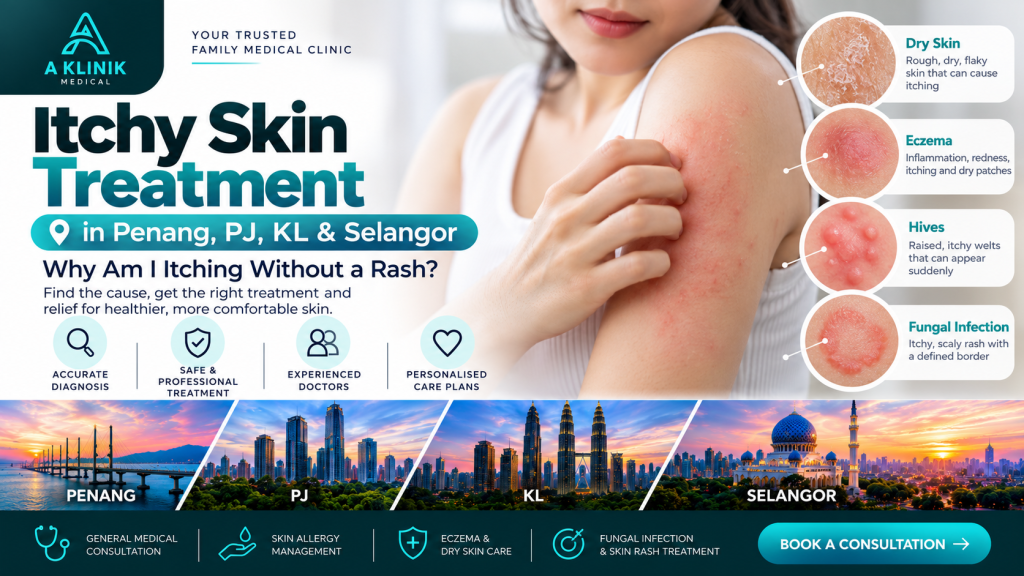


Itchy Skin Treatment in Penang, PJ, KL & Selangor: Why Am I Itching Without a Rash?
Itchy skin can be frustrating, especially when the itching keeps returning or there is no obvious rash to explain it. Some people experience itching in one specific area, while others feel itchy across their entire body. For some, the symptoms become particularly uncomfortable at night, affecting sleep and daily activities.
The medical term for itching is pruritus. Itching is a symptom rather than a diagnosis, which means there are many possible underlying causes.
Dry skin, eczema, skin allergies, fungal infections, hives, scabies and other skin conditions can all cause itching. In some cases, persistent or widespread itching may also be associated with medications or underlying medical conditions.
For patients looking for itchy skin treatment in Penang, PJ, KL & Selangor, understanding the cause is an important first step towards appropriate management.
At A Klinik Medical, our approach focuses on assessing the symptoms, examining the skin and considering relevant medical factors before recommending suitable treatment.
What Causes Itchy Skin?
Itchy skin can occur when nerves in the skin and nervous system respond to signals triggered by irritation, inflammation, dryness, infection or other factors.
Common causes include:
- Dry skin (xerosis)
- Eczema or atopic dermatitis
- Allergic or irritant contact dermatitis
- Hives (urticaria)
- Fungal skin infections
- Scabies
- Psoriasis
- Insect bites
- Certain medications
- Other underlying medical conditions
The location, duration, appearance and pattern of itching can provide important clues.
For example, an itchy, circular, scaly rash may suggest a different condition from widespread itching without any visible skin changes.
This is why effective itchy skin treatment should focus on identifying the underlying cause rather than simply providing temporary relief.
Why Is My Skin Itchy but There Is No Rash?
One of the most common questions patients ask is, “Why am I itching when there is no rash?”
Itching does not always produce visible changes on the skin.
Dry skin is one possible explanation. The skin may look relatively normal but still feel tight, sensitive or itchy, particularly after frequent washing, hot showers or prolonged exposure to air conditioning.
Sometimes, a skin condition may be at an early stage, when visible signs are still subtle.
Persistent itching without a rash may also be associated with medications, neurological factors or certain medical conditions affecting other parts of the body.
If itching continues for an extended period, affects large areas of the body or interferes with sleep, medical assessment may be appropriate.
Dry Skin and Itching
Dry skin, also known as xerosis, is a common cause of itchy skin.
When the skin barrier loses moisture, the skin may become rough, flaky, tight or sensitive. Some people experience significant itching even when dryness is not particularly visible.
Contributing factors may include frequent hot showers, harsh cleansers, excessive washing, ageing, air-conditioned environments and certain medical conditions.
Repeated scratching can worsen the problem by damaging the skin barrier.
This creates an itch-scratch cycle:
Itching → Scratching → Skin barrier damage → Increased irritation → More itching
Regular moisturising, gentle cleansing and avoiding unnecessary irritation may help when dry skin is the main cause.
However, moisturisers alone may not resolve itching caused by infections, infestations or other medical conditions.
Eczema and Itchy Skin
Eczema is a common inflammatory skin condition associated with itching, dryness and recurring flare-ups.
Symptoms may include dry or scaly patches, redness, rough skin, cracking and increased sensitivity.
For some patients, itching becomes particularly troublesome at night.
Scratching can further damage the skin barrier, increase inflammation and sometimes contribute to secondary infection.
Eczema management often focuses on reducing inflammation, supporting the skin barrier, managing relevant triggers and preventing repeated scratching.
Depending on severity, treatment may include moisturisers and appropriately selected topical anti-inflammatory medication.
Skin Allergy and Itching
Many people assume that itchy skin automatically means they have an allergy.
Although allergies can cause itching, not every itchy skin condition is caused by an allergic reaction.
Allergic contact dermatitis occurs when the immune system reacts to a substance that touches the skin.
Possible triggers include fragrances, certain metals, cosmetics, skincare ingredients, hair products, adhesives and occupational chemicals.
Symptoms may include itching, redness, swelling and a visible rash.
However, irritant contact dermatitis can cause similar symptoms without involving a true allergy.
Identifying the relevant trigger is important because repeatedly using anti-itch medication may not resolve the problem if exposure continues.
Contact Dermatitis: Could Your Skincare Be Causing the Itch?
Skincare and cosmetic products can sometimes cause irritation or allergic reactions.
Patients may notice symptoms after introducing a new cleanser, serum, sunscreen, perfume, hair dye, laundry detergent or topical medication.
When several new products are introduced at once, identifying the responsible product can become difficult.
A medical assessment may include reviewing recent exposures, the affected skin areas and the timing of symptoms.
In selected cases of suspected allergic contact dermatitis, patch testing may be considered.
Patch testing is different from general allergy blood testing and should be selected according to the clinical situation.
Hives and Itchy Skin
Hives, also known as urticaria, are raised itchy welts that can appear suddenly.
Individual welts may change shape, disappear and reappear in different locations.
Hives may be associated with infections, medications, foods or other triggers, although a specific cause is not always identifiable.
Chronic hives do not automatically mean that a food allergy is responsible.
Antihistamines are commonly used in managing urticaria, but treatment depends on the patient’s symptoms and medical history.
If hives occur together with breathing difficulty, throat or tongue swelling, fainting or severe dizziness, emergency medical attention is required.
Fungal Skin Infection and Itching
Malaysia’s warm and humid climate can create favourable conditions for certain fungal skin infections.
Common examples include ringworm, athlete’s foot, fungal infections affecting the groin and infections in skin folds.
Symptoms may include itching, redness, scaling, peeling or a rash with a defined border.
Fungal infections can sometimes resemble eczema or other inflammatory skin conditions.
This matters because inappropriate use of steroid-containing creams may change the appearance of certain fungal infections and complicate diagnosis.
When a fungal infection is suspected, suitable antifungal treatment may be required. The type and duration depend on the location, severity and diagnosis.
Patients with recurrent fungal infections may also need to consider persistent moisture, sweating, reinfection or incomplete treatment.
Scabies and Severe Itching at Night
Scabies is a contagious skin infestation caused by the Sarcoptes scabiei mite.
A characteristic symptom is intense itching, which may become more noticeable at night.
Affected areas can include the fingers, wrists, waist, underarms, groin and buttocks.
Other household members or close contacts may also develop itching.
However, nighttime itching alone does not confirm scabies, because eczema and other conditions can also become more troublesome at night.
Scabies requires specific treatment. Close contacts and relevant clothing or bedding may also need attention according to medical guidance.
Importantly, itching may continue temporarily even after successful treatment. Persistent symptoms should be reassessed rather than automatically assumed to indicate treatment failure.
Psoriasis and Itchy Skin
Psoriasis is a chronic inflammatory condition that may cause thickened, scaly or inflamed skin patches.
Some patients also experience significant itching.
Because psoriasis can resemble eczema or certain fungal infections, medical assessment may be needed to distinguish between these conditions.
Treatment depends on the type, severity, location and extent of the condition.
Why Is My Whole Body Itchy?
Generalised itching refers to itching affecting much of the body rather than one isolated area.
Dry skin is a common cause, especially among older adults, but widespread itching can have other explanations.
Depending on the patient’s medical history, persistent generalised itching may sometimes be associated with medications or conditions involving the liver, kidneys, thyroid, blood or nervous system.
This does not mean that whole-body itching automatically indicates a serious illness.
However, when itching is persistent and no clear skin cause is found, further medical assessment may be appropriate.
Why Does My Skin Itch More at Night?
Nighttime itching may occur because of skin dryness, changes in skin temperature, underlying inflammatory conditions or increased awareness of symptoms when resting.
Eczema and scabies are among the conditions that may cause troublesome nighttime itching.
Repeated scratching during sleep can damage the skin and affect sleep quality.
If itching regularly wakes you from sleep or continues despite appropriate care, a medical consultation may help identify the cause.
Can Stress Cause Itchy Skin?
Stress may worsen itching or contribute to flare-ups of certain inflammatory skin conditions.
It can also influence the itch-scratch cycle, where increased scratching leads to further irritation.
However, persistent itching should not automatically be dismissed as stress-related.
Other possible skin or medical causes should still be considered.
Can Medication Cause Itchy Skin?
Certain medications may cause itching, sometimes with a visible rash and sometimes without one.
If itching begins after starting a new medication, the timing should be discussed with a healthcare professional.
Patients should not stop important prescribed medication without appropriate medical advice.
Severe reactions involving breathing difficulty, facial or throat swelling, widespread blistering or peeling skin require urgent medical attention.
How Is Itchy Skin Treated?
The appropriate treatment depends on the underlying diagnosis.
For patients searching for itchy skin treatment in Penang, PJ, KL & Selangor, a medical assessment can help determine whether the symptoms are related to dryness, inflammation, allergy, infection, infestation or another condition.
Treatment options may include:
1. Moisturisers and Skin Barrier Care
Regular moisturising can help patients whose itching is related to dry skin or impaired skin barrier function.
Gentle, fragrance-free products may be appropriate for some patients with sensitive or eczema-prone skin.
2. Topical Anti-Inflammatory Medication
Certain inflammatory skin conditions, including eczema, may require topical anti-inflammatory treatment.
Medication type, strength, application site and treatment duration should be selected according to the diagnosis.
3. Antihistamines
Antihistamines may be particularly useful for histamine-related conditions such as hives.
However, not every type of itching responds equally well to antihistamines.
4. Antifungal Treatment
When itching is caused by a fungal infection, appropriate antifungal medication may be needed.
Treatment should follow the recommended course to reduce the risk of persistent infection.
5. Scabies Treatment
Scabies requires medication directed at the mites.
Close contacts and relevant environmental measures may also be considered to prevent reinfestation.
6. Further Medical Investigation
Persistent generalised itching without an obvious skin explanation may require additional evaluation.
Blood tests or other investigations are not necessary for every patient. They should be selected based on clinical findings.
Are Steroid Creams Safe for Itchy Skin?
Topical corticosteroids are useful for many inflammatory skin conditions when used correctly.
However, they should not be treated as universal anti-itch creams.
Different preparations have different strengths, and inappropriate prolonged use may cause side effects.
Applying steroid-containing creams to an undiagnosed fungal rash can also complicate management.
The important question is not which cream is strongest, but whether the condition requires a steroid and which preparation is suitable.
Should I Do an Allergy Test for Itchy Skin?
Not every patient with itchy skin requires allergy testing.
Testing should be guided by the symptoms, clinical history and suspected trigger.
For example, suspected allergic contact dermatitis may sometimes require patch testing, while other allergy-related conditions may need a different approach.
Broad allergy testing without a clear clinical indication may not explain the symptoms.
Do I Need a Blood Test for Persistent Itching?
Blood tests are not routinely required for every itchy skin complaint.
When the cause is clear from the skin examination, treatment may focus directly on the diagnosed condition.
However, when itching is widespread, unexplained or persistent, a doctor may consider appropriate investigations.
The decision depends on medical history, associated symptoms and examination findings.
How Can I Stop Itching at Night?
While treatment depends on the cause, several practical measures may help reduce irritation:
- Avoid excessively hot showers.
- Use an appropriate moisturiser if the skin is dry.
- Keep fingernails short.
- Avoid known irritating skincare products.
- Wear comfortable clothing.
- Keep the sleeping environment comfortable.
- Follow prescribed treatment consistently.
If eczema, scabies, hives or another condition is responsible, managing that condition is more important than relying only on temporary relief.
Can Scratching Cause a Skin Infection?
Yes. Repeated scratching can damage the skin barrier and create small breaks in the skin.
This may increase the risk of secondary infection.
Warning signs include increasing pain, warmth, swelling, redness, pus, discharge or crusting.
Fever or rapidly spreading redness may indicate a more significant infection and should be medically assessed promptly.
Can Itchy Skin Leave Dark Marks?
Repeated inflammation and scratching may lead to post-inflammatory pigmentation.
These marks can remain even after the original itching improves.
The first priority is usually to manage the underlying cause and reduce ongoing skin damage.
Persistent pigmentation can be assessed separately once the condition is controlled.
Why Does My Itchy Skin Keep Coming Back?
Recurring itchy skin can have several explanations.
Possible reasons include ongoing exposure to irritants or allergens, repeated eczema flare-ups, persistent dryness, reinfection, incomplete treatment, incorrect diagnosis or other medical factors.
If symptoms improve with treatment but return repeatedly, reassessment may help determine whether the diagnosis or treatment plan needs to change.
Itchy Skin Treatment for Children
Children may develop itchy skin from eczema, insect bites, scabies and other skin conditions.
Treatment should consider the child’s age, symptoms and diagnosis.
Parents should avoid repeatedly applying strong medicated creams without appropriate guidance.
Persistent itching that affects sleep or causes significant skin damage should be assessed.
Itchy Skin During Pregnancy
Itching during pregnancy can occur due to skin dryness, stretching and other pregnancy-related changes.
However, significant itching, particularly without a rash or involving the palms and soles, should be discussed promptly with a maternity healthcare professional because pregnancy-related liver conditions may need to be excluded.
Medication selection during pregnancy also requires additional consideration.
When Should You See a Doctor for Itchy Skin?
Medical assessment may be appropriate when itching is persistent, recurring, widespread or unexplained.
Other reasons include:
- Itching that interferes with sleep
- A spreading rash
- Skin that becomes painful or infected
- Symptoms that do not improve with appropriate self-care
- Several household members developing similar itching
- Itching following a new medication
- Other unexplained symptoms
A doctor can assess whether the itching is likely related to a skin condition or whether further medical evaluation may be appropriate.
When Is Itchy Skin an Emergency?
Most cases of itching are not medical emergencies.
However, emergency attention is required when itching or hives are accompanied by difficulty breathing, throat or tongue swelling, fainting or severe dizziness.
Severe widespread blistering, peeling skin or rapidly worsening reactions after medication also require urgent assessment.
These symptoms should not wait for a routine clinic appointment.
Why Choose A Klinik Medical for Itchy Skin Treatment?
At A Klinik Medical, we focus on identifying the possible cause of itchy skin rather than assuming every patient needs the same medication.
Our medical approach considers symptoms, skin examination, medical history, potential triggers and previous treatment response.
Depending on the diagnosis, management may involve skin barrier care, appropriate medication, further investigation or follow-up.
For patients looking for itchy skin treatment in Penang, PJ, KL & Selangor, the objective is to understand why itching occurs and provide a treatment plan based on the individual condition.
Itchy Skin Treatment Locations in Penang, PJ, KL & Selangor
Penang
Patients in Penang can consider A Klinik Medical locations including Jelutong, Bayan Lepas, Raja Uda and Relau for medical consultation, subject to branch services and availability.
Petaling Jaya (PJ)
Patients in Petaling Jaya can consider A Klinik Medical’s wider Klang Valley clinic network for assessment of persistent itchy skin. There is no separate A Klinik Medical PJ branch listed here.
Kuala Lumpur (KL)
Patients in Kuala Lumpur may consider A Klinik Medical Cheras for medical consultation, depending on operating status and service availability.
Selangor
Patients across Selangor may consider A Klinik Medical locations including Puchong, Klang and Gombak, subject to current operating status and available services.
For updated branch details, visit the
A Klinik clinic locations page.
Frequently Asked Questions About Itchy Skin
1. Why am I itchy all over but have no rash?
Whole-body itching without an obvious rash can be caused by dry skin, medications or certain underlying medical conditions. Persistent or unexplained itching should be assessed, particularly when accompanied by other symptoms.
2. What is the best treatment for itchy skin?
There is no single best treatment. Dry skin, eczema, fungal infections, hives and scabies require different approaches. Identifying the underlying cause is essential.
3. Why does my skin itch more at night?
Nighttime itching may occur with dry skin, eczema, scabies and other conditions. If it regularly affects sleep or several household members are itchy, medical assessment may be useful.
4. Can I take antihistamines for itchy skin?
Antihistamines may help certain causes of itching, particularly hives. However, not all itching is driven by histamine, and other treatments may be necessary.
5. Where can I get itchy skin treatment in Penang, PJ, KL & Selangor?
Patients can seek medical skin assessment at suitable A Klinik Medical branches across Penang, Kuala Lumpur and Selangor. Patients from PJ may consider the wider Klang Valley clinic network. Branch services and operating hours should be confirmed before visiting.
Conclusion
Itchy skin may appear to be a simple concern, but there are many possible causes.
Dry skin, eczema, allergies, contact dermatitis, hives, fungal infections, scabies and psoriasis can all produce itching. Persistent generalised itching without a visible rash may sometimes require broader medical assessment.
The most important question is not simply how to stop itching temporarily, but why the skin is itching.
For patients looking for itchy skin treatment in Penang, PJ, KL & Selangor, A Klinik Medical focuses on identifying the likely cause, selecting appropriate treatment and monitoring the response when needed.
Understanding the underlying condition is an important step towards healthier, more comfortable skin.
Medically Reviewed By Dr. Aaron Low