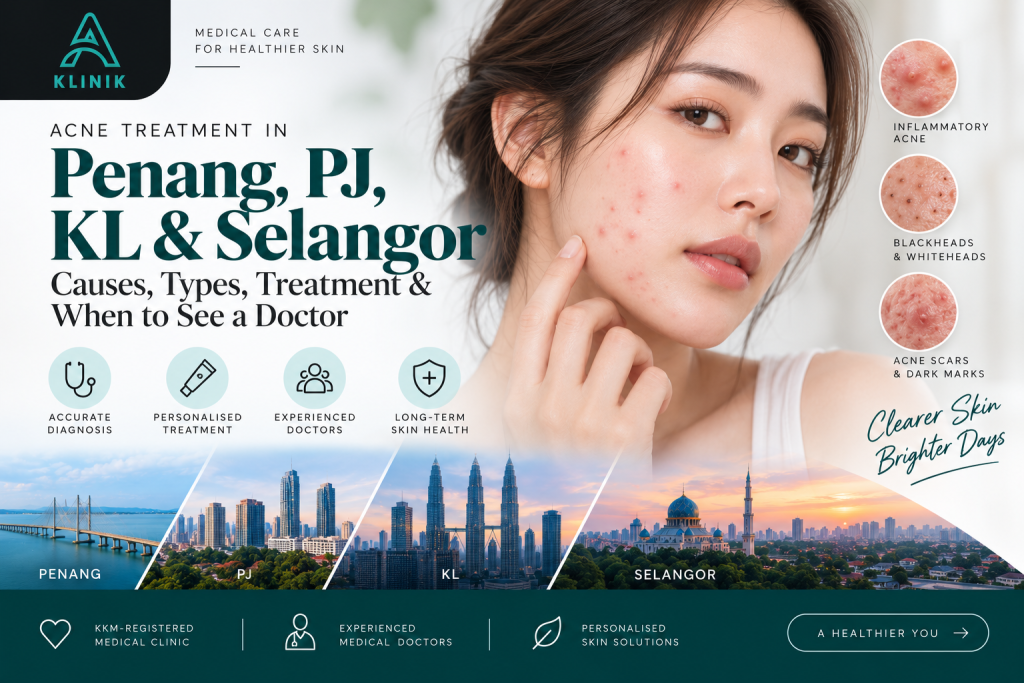


Acne Treatment in Penang, PJ, KL & Selangor: Causes, Types, Treatment & When to See a Doctor
Introduction
Acne is one of the most common skin conditions worldwide, affecting teenagers and adults alike. While many people associate acne with adolescence, it can occur at any age and may continue well into adulthood. For some individuals, acne is an occasional breakout, while for others, it becomes a persistent condition that affects confidence, emotional wellbeing and quality of life.
Acne is more than just a cosmetic concern. Persistent inflammatory acne may lead to acne scars, post-inflammatory pigmentation and long-term skin changes that become more difficult to manage over time.
Although countless skincare products promise clear skin, not every acne treatment works for every individual because acne has multiple underlying causes.
If you’re searching for acne treatment in Penang, PJ, KL & Selangor, the first step is obtaining an appropriate medical assessment. Different types of acne require different treatment approaches, and what works for one person may not be suitable for another.
At A Klinik Medical, our medical doctors provide personalised acne assessment and treatment plans to help patients manage active acne, reduce inflammation, minimise recurring breakouts and reduce the risk of acne scars.
In this guide, we’ll explain what causes acne, the different types of acne, available acne treatment options and when you should consult a doctor.
What Is Acne?
Acne, also known as acne vulgaris, is a chronic inflammatory skin condition involving hair follicles and their associated oil glands.
It develops through a combination of excess oil production, abnormal shedding of skin cells, blocked follicles, bacterial activity and inflammation.
These processes can lead to different types of acne lesions, including:
- Whiteheads
- Blackheads
- Papules
- Pustules
- Nodules
- Cyst-like inflammatory lesions
Although acne most commonly appears on the face, it can also affect the chest, back, shoulders and neck.
The severity of acne varies significantly between individuals. Some people experience only a few occasional pimples, while others develop widespread inflammatory acne that may leave permanent scars.
Because acne has several contributing factors, successful treatment focuses on managing the underlying processes rather than simply treating individual pimples.
What Causes Acne?
Many patients ask, “Why am I still getting acne?”
Acne usually develops due to a combination of factors rather than a single cause.
Understanding these contributing factors helps doctors recommend an appropriate treatment plan.
Excess Oil Production
Sebaceous glands naturally produce oil, known as sebum, to protect and moisturise the skin.
However, excessive oil production can combine with dead skin cells and contribute to blocked hair follicles, creating conditions in which acne develops more easily.
Blocked Hair Follicles
Skin cells naturally shed every day.
When dead skin cells accumulate inside hair follicles instead of shedding normally, they can mix with excess oil and contribute to blocked pores.
These blocked follicles form the beginning of many acne lesions.
Bacteria
A type of bacteria called Cutibacterium acnes, formerly known as Propionibacterium acnes, normally lives on human skin.
Its activity within blocked follicles can contribute to inflammation and the development of acne lesions.
However, acne is not simply a bacterial infection. Oil production, follicular blockage and the body’s inflammatory response also play important roles.
Hormonal Changes
Hormones play an important role in acne development.
Hormonal influences may contribute to acne during:
- Puberty
- Menstrual cycles
- Pregnancy
- Certain hormonal disorders
- Polycystic Ovary Syndrome (PCOS)
Hormonal fluctuations can influence oil production and make breakouts more likely in susceptible individuals.
Genetics
Family history also influences acne.
People whose close family members experienced significant acne may have a greater likelihood of developing the condition.
However, genetics is only one part of the picture, and other factors also contribute.
Lifestyle Factors
Certain lifestyle habits may contribute to acne flare-ups in some individuals.
These may include:
- Chronic stress
- Poor sleep
- High-glycaemic dietary patterns
- Frequent touching or picking of the face
- Heavy or pore-clogging cosmetics
- Prolonged friction from tight helmets or masks
Lifestyle factors do not explain every case of acne, but they may worsen existing breakouts in susceptible individuals.
Different Types of Acne
Not all acne looks the same.
Correctly identifying the type of acne is important because different forms of acne may require different treatment approaches.
Whiteheads
Whiteheads develop when a blocked follicle remains closed at the skin surface.
They typically appear as small, skin-coloured or whitish bumps with little visible inflammation.
Blackheads
Blackheads occur when blocked follicles remain open at the skin surface.
The dark colour is not caused by dirt. It develops through changes in the material within the follicle, including oxidation.
Papules
Papules are small, inflamed bumps without visible pus.
They may feel tender when touched.
Pustules
Pustules are inflammatory acne lesions containing visible pus.
They are commonly recognised as pimples.
Nodules
Nodules develop deeper within the skin and may feel firm and painful.
Because they involve deeper inflammation, they carry a greater risk of permanent acne scarring.
Cystic Acne
The term cystic acne is commonly used to describe severe acne involving deep, painful inflammatory lesions.
Symptoms may include:
- Large, painful lumps
- Significant inflammation
- Persistent deep lesions
- Increased risk of permanent acne scars
Patients with severe nodular or cyst-like acne should seek medical assessment early to reduce the risk of long-term skin damage.
Why Do Adults Still Get Acne?
Many people believe acne only affects teenagers.
In reality, acne can continue into adulthood or develop for the first time later in life.
Adult acne may be associated with:
- Hormonal fluctuations
- Stress
- Cosmetic products
- Certain medications
- Underlying medical conditions
- Genetics
Adult acne may affect areas such as the chin, jawline and lower cheeks, although it can also appear elsewhere.
Some patients experience persistent or recurring breakouts despite following a regular skincare routine.
Because adult acne may sometimes be associated with hormonal or medical conditions, professional assessment can help determine an appropriate treatment approach.
Common Symptoms of Acne
Acne symptoms vary depending on the type and severity of the condition.
Some people experience occasional blackheads or whiteheads, while others develop painful inflammatory lesions that may lead to scarring.
Recognising the early signs of acne can help patients seek appropriate acne treatment before the condition becomes more severe.
Whiteheads and Blackheads
Whiteheads and blackheads are known as comedones.
They develop when hair follicles become blocked by oil and accumulated skin cells.
They are generally less inflamed than papules, pustules or nodules.
Red, Inflamed Pimples
Inflammatory acne may appear as:
- Red or discoloured bumps
- Tender papules
- Pus-filled pustules
- Swollen pimples
These lesions develop through inflammatory processes within affected hair follicles.
Painful Nodules and Cyst-Like Lesions
Moderate to severe acne may involve deeper inflammation beneath the skin.
These larger lesions can be painful and may persist for an extended period.
Because deeper inflammatory lesions carry a greater risk of permanent scarring, early medical treatment is important.
Acne Scars
One of the potential complications of inflammatory acne is permanent scarring.
Acne scars may appear as:
- Rolling scars
- Boxcar scars
- Ice-pick scars
- Depressed scars
- Uneven skin texture
Early medical acne treatment can help reduce the risk of permanent scarring, although it cannot guarantee that scars will never develop.
Post-Inflammatory Hyperpigmentation (PIH)
After acne heals, some patients develop dark marks or pigmentation.
These marks are not the same as depressed acne scars.
Post-inflammatory hyperpigmentation may persist for months, particularly in individuals with darker skin tones.
Managing active acne and avoiding unnecessary skin irritation can help reduce the development of new marks.
How Is Acne Diagnosed?
Many patients assume all acne is the same.
However, successful treatment begins with identifying the type and severity of the condition.
At A Klinik Medical, our doctors may assess:
- Type of acne lesions
- Severity of inflammation
- Areas affected
- Duration of acne
- Previous treatments
- Medical history
- Family history
- Lifestyle factors
- Possible hormonal influences
During consultation, your doctor may also consider whether another skin condition could resemble acne.
Examples include:
- Rosacea
- Folliculitis
- Perioral dermatitis
- Malassezia folliculitis, sometimes called fungal acne
Accurate diagnosis helps determine an appropriate acne treatment plan rather than relying solely on trial-and-error skincare products.
Acne Treatment Options
There is no single treatment that works for every patient.
The most appropriate acne treatment depends on several factors, including the type of acne, severity, skin condition, age, medical history, presence of scarring and possible hormonal influences.
For patients seeking acne treatment in Penang, PJ, KL & Selangor, medical assessment can help determine whether skincare, prescription treatment or a more comprehensive management approach is appropriate.
Medical Skincare
For mild acne, your doctor may recommend a skincare routine designed to:
- Reduce excess oil
- Help prevent blocked pores
- Support normal skin-cell turnover
- Maintain the skin barrier
- Minimise unnecessary irritation
Skincare may be combined with prescription treatment depending on the condition.
Prescription Topical Medications
Topical medications are commonly used to treat acne and help prevent new lesions.
Depending on the patient’s condition, a doctor may consider treatments such as topical retinoids, benzoyl peroxide, azelaic acid or other appropriate medications.
Some patients may also require topical antibiotics as part of a suitable treatment regimen.
The choice of medication depends on acne severity, skin tolerance, medical history and other individual factors.
Patients should follow their doctor’s instructions to minimise irritation and use medication appropriately.
Oral Medications
Patients with moderate to severe acne, persistent inflammatory lesions or acne that has not responded adequately to topical treatment may require oral medication.
Depending on individual suitability, treatment may involve:
- Oral antibiotics
- Hormonal treatment for selected patients
- Isotretinoin for appropriate cases
These treatments have different indications, precautions and monitoring requirements.
For example, isotretinoin requires medical supervision and must not be used during pregnancy because of its serious risk to an unborn baby.
Your doctor should discuss the appropriate option based on your medical history and acne severity.
Lifestyle Advice
Although lifestyle changes alone may not adequately control acne, healthy habits can support long-term skin care.
Your doctor may recommend:
- A consistent skincare routine
- Gentle cleansing
- Avoiding picking or squeezing pimples
- Managing stress
- Getting adequate sleep
- Maintaining a balanced diet
These measures are most useful when combined with appropriate treatment where needed.
Can Acne Scars Be Prevented?
One of the most common questions patients ask is, “Will my acne leave scars?”
Not everyone with acne develops permanent scars.
However, the risk can increase when:
- Acne is severe
- Deep inflammatory lesions develop
- Treatment is delayed
- Pimples are repeatedly picked or squeezed
- Inflammation persists
Controlling active acne early is an important part of reducing the risk of acne scarring.
If acne scars have already developed, your doctor may discuss additional management options once active acne is appropriately controlled.
Common Acne Myths
There are many misconceptions surrounding acne.
Myth 1: Acne Is Caused by Poor Hygiene
Acne is not simply caused by dirty skin.
It involves several biological processes, including oil production, follicular blockage and inflammation.
Overwashing or harsh scrubbing may irritate the skin and worsen discomfort.
Myth 2: Chocolate Always Causes Acne
Chocolate alone has not been established as a universal cause of acne.
However, certain dietary patterns, including high-glycaemic diets, may contribute to breakouts in some individuals.
The relationship between diet and acne varies.
Myth 3: You Should Squeeze Pimples
Picking or squeezing pimples can worsen inflammation and increase the risk of skin injury, pigmentation and scarring.
It is generally better to avoid manipulating inflammatory acne lesions.
Myth 4: Acne Only Affects Teenagers
Acne can affect teenagers and adults.
Some individuals experience acne well into their 30s, 40s or later.
Myth 5: Acne Will Always Disappear on Its Own
Mild acne may improve naturally in some individuals.
However, persistent or inflammatory acne should not be ignored, particularly when painful lesions, dark marks or scarring develop.
When Should You See a Doctor for Acne?
Many people believe acne is simply a normal part of growing up and will eventually disappear.
While mild acne may improve over time, persistent or moderate to severe acne often benefits from professional medical treatment.
You should consider seeing a doctor if:
- Acne persists despite using over-the-counter products.
- You develop painful nodules or cyst-like lesions.
- Acne is leaving scars or dark marks.
- Breakouts become more frequent or severe.
- Acne affects your confidence or daily activities.
- You suspect hormonal acne or another underlying condition.
- Acne affects large areas such as the face, chest, shoulders or back.
For patients looking for acne treatment in Penang, PJ, KL & Selangor, early medical assessment can help identify the type of acne and determine an appropriate treatment plan.
Can Acne Be Prevented?
Acne cannot always be completely prevented, but appropriate skincare and early management can help reduce breakouts.
Helpful habits include:
- Washing your face gently, usually twice daily.
- Using non-comedogenic skincare and cosmetic products.
- Avoiding squeezing or picking pimples.
- Removing makeup before sleeping.
- Wearing suitable sunscreen daily.
- Managing stress where possible.
- Maintaining a balanced diet.
- Seeking medical advice if acne becomes persistent.
Reducing severe and prolonged inflammation is particularly important for lowering the risk of long-term acne scars.
Living With Acne
Acne is not simply a cosmetic concern. It can also affect emotional wellbeing and self-confidence.
Some patients may feel uncomfortable taking photographs, attending social gatherings or participating in everyday activities because of persistent breakouts.
These concerns deserve attention alongside the physical symptoms.
Acne is a treatable medical condition, and many patients experience meaningful improvement with appropriate assessment, treatment and follow-up.
If acne is affecting your quality of life, seeking professional medical advice is an important step towards managing the condition.
Acne Treatment in Penang
Patients seeking acne treatment in Penang may experience concerns ranging from occasional whiteheads and blackheads to persistent inflammatory acne, adult acne and acne-related pigmentation.
A Klinik Medical has clinics serving patients across Penang, including Jelutong, Bayan Lepas, Raja Uda and Relau.
Medical consultation can help identify the type and severity of acne before an appropriate treatment plan is recommended.
Acne Treatment in PJ
Patients searching for acne treatment in PJ or Petaling Jaya may require assessment for persistent breakouts, adult acne, inflammatory lesions or recurring acne around the chin and jawline.
A Klinik Medical’s wider Klang Valley network serves patients in Selangor and surrounding areas.
Treatment should be based on the patient’s skin condition and medical history rather than assuming every breakout requires the same skincare products or medication.
Acne Treatment in KL
For patients looking for acne treatment in KL, persistent acne, painful inflammatory lesions or recurring breakouts may benefit from medical assessment.
A Klinik Medical’s Klang Valley network includes Cheras and other locations serving the wider area.
An appropriate consultation can help distinguish acne from similar-looking skin conditions and determine suitable management.
Acne Treatment in Selangor
Patients seeking acne treatment in Selangor can consider medical assessment for concerns such as adult acne, inflammatory acne, persistent breakouts and acne-related dark marks.
A Klinik Medical’s Klang Valley locations include Puchong, Klang and Gombak.
Treatment plans are personalised according to acne type, severity, skin condition, previous treatment response and individual needs.
Why Choose A Klinik Medical?
At A Klinik Medical, we believe healthy skin begins with appropriate diagnosis, evidence-based treatment and personalised medical care.
Every patient’s acne is different. Our medical doctors assess the skin condition, medical history, lifestyle and treatment goals before recommending an appropriate management plan.
Whether you’re experiencing mild acne, adult acne, hormonal acne, severe inflammatory acne or concerns about acne scars, our focus is on understanding the condition rather than simply treating visible breakouts.
Our approach includes:
- Medical assessment by experienced doctors
- KKM-registered medical clinics
- Evidence-based treatment planning
- Personalised recommendations
- Management of acne and other common skin conditions
- Patient education
- Appropriate follow-up
A Klinik Medical’s clinic network covers Penang and the Klang Valley, including:
Penang
- Jelutong
- Bayan Lepas
- Raja Uda
- Relau
Klang Valley
- Cheras
- Puchong
- Klang
- Gombak
Whether you’re seeking acne treatment or medical care for eczema, psoriasis, skin allergies, fungal infections, rosacea or other skin concerns, our goal is to provide appropriate medical assessment and personalised care.
Conclusion
Acne is one of the most common skin conditions, but it is also frequently misunderstood.
It is a complex inflammatory condition influenced by several factors, including hormones, oil production, follicular blockage, bacterial activity and genetics.
Because different types of acne require different treatment approaches, obtaining an accurate diagnosis is important before beginning treatment.
Early acne treatment can help control active breakouts, reduce inflammation and lower the risk of acne scars and post-inflammatory pigmentation.
For patients seeking acne treatment in Penang, PJ, KL & Selangor, A Klinik Medical provides medical assessment and personalised treatment planning for a range of acne concerns.
Rather than relying on a one-size-fits-all approach, consultation with a medical doctor can help you better understand your condition and determine an appropriate management plan.
Frequently Asked Questions (FAQ)
1. What Causes Acne?
Acne develops through a combination of excess oil production, blocked hair follicles, bacterial activity and inflammation. Hormonal changes, genetics and certain lifestyle factors may also contribute to breakouts.
2. Can Acne Be Cured Permanently?
There is no single permanent cure that applies to every patient. However, many people achieve effective long-term acne control with appropriate medical treatment, skincare and follow-up.
3. When Should I See a Doctor for Acne?
Consider medical assessment if your acne persists despite over-the-counter products, becomes painful, leaves scars or affects your confidence and daily life.
4. Does Eating Chocolate Cause Acne?
Chocolate alone has not been established as a universal cause of acne. However, high-glycaemic dietary patterns may contribute to breakouts in some individuals.
5. Can Acne Scars Be Prevented?
The risk of acne scars can often be reduced through early treatment of inflammatory acne, avoiding picking or squeezing pimples and following an appropriate management plan. However, scarring cannot always be completely prevented.
Medically Reviewed By Dr. Aaron Low