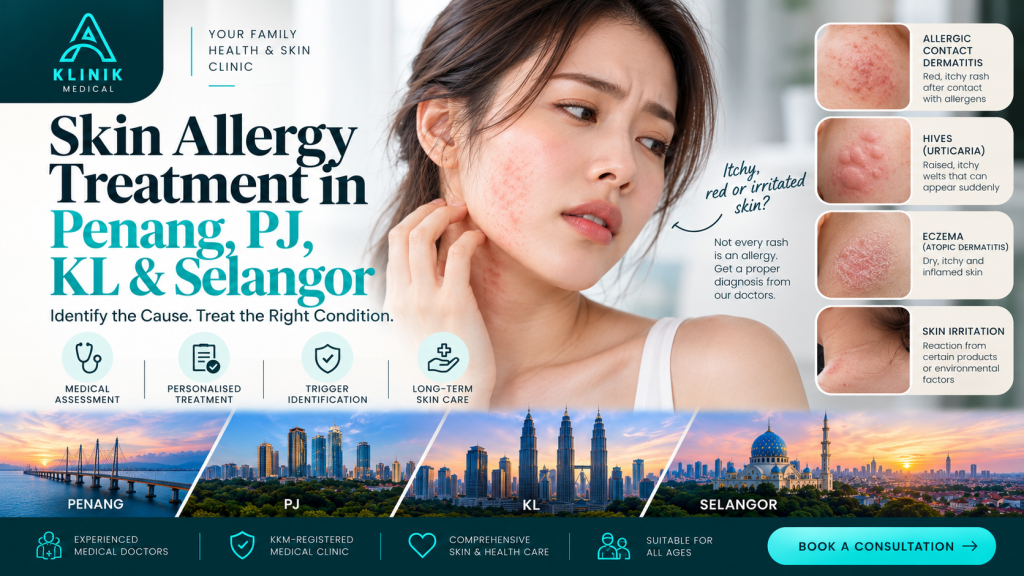


Skin Allergy Treatment in Penang, PJ, KL & Selangor: Causes, Symptoms & When to See a Doctor
Is Your Itchy Skin Really a Skin Allergy?
Red, itchy or irritated skin is commonly described as a “skin allergy.”
But not every itchy rash is caused by an allergic reaction.
Eczema, contact dermatitis, hives, fungal infections, insect bites, medication reactions, dry skin and other medical conditions can sometimes produce similar symptoms.
This is why effective skin allergy treatment should begin with identifying the possible cause rather than simply applying an anti-itch cream.
For patients searching for skin allergy treatment in Penang, PJ, KL & Selangor, a medical assessment can help determine whether the symptoms are related to an allergic reaction, another inflammatory skin condition, an infection or another possible cause.
At A Klinik Medical, our doctors assess the appearance of the skin, symptoms, medical history, possible exposures and triggers before recommending an individualised treatment plan.
What Is a Skin Allergy?
A skin allergy occurs when the immune system reacts to a substance that triggers an allergic response.
Depending on the condition, symptoms may include:
- Itching
- Redness
- Raised bumps
- Hives or welts
- Swelling
- Dry or irritated skin
- Blisters
- Flaking or scaling
However, the appearance alone may not always reveal the exact cause.
For example, an itchy red rash after using a new skincare product could be related to allergic contact dermatitis — but irritation from the product can also cause a reaction without a true allergy.
Therefore, patients looking for skin allergy treatment should avoid assuming that every reaction has the same underlying mechanism.
Common Types of Allergic Skin Reactions
“Skin allergy” is a broad term rather than one single condition.
Several different conditions can involve allergic or immune-related reactions.
1. Allergic Contact Dermatitis
Allergic contact dermatitis develops when the skin develops an immune reaction after contact with a substance to which the person has become sensitised.
Potential allergens can include substances found in:
- Fragrances
- Cosmetics
- Hair products
- Metals such as nickel
- Certain preservatives
- Rubber-related materials
- Personal-care products
- Some topical medications
The reaction usually occurs in areas that have been exposed to the allergen, although it can sometimes spread beyond the original contact area.
Symptoms may include itching, redness, swelling, dry or cracked skin and, in some cases, blisters.
For patients seeking skin allergy treatment in Penang, PJ, KL & Selangor, identifying the suspected trigger is an important part of preventing repeated reactions.
2. Hives or Urticaria
Hives, medically known as urticaria, are raised, itchy welts that can suddenly appear on the skin.
They may:
- Change shape
- Vary in size
- Appear anywhere on the body
- Disappear and reappear
- Move from one area to another
Individual hives often disappear relatively quickly, although new ones may continue developing.
Hives may occur in association with allergic reactions, but not every episode of urticaria is caused by an allergy.
Other possible triggers can include infections, medications and physical triggers such as pressure, temperature or exercise.
This is why recurring hives should not automatically lead patients to eliminate multiple foods without medical assessment.
3. Eczema and Atopic Dermatitis
Patients commonly describe eczema as a skin allergy.
There is some overlap because atopic dermatitis is associated with immune and skin-barrier dysfunction and can occur in people with other atopic conditions.
However, eczema is more complex than simply being “allergic to something.”
Common symptoms include:
- Persistent itching
- Dry skin
- Red or inflamed patches
- Scaling
- Cracking
- Thickened skin after repeated scratching
- Recurrent flare-ups
Different factors may worsen eczema, including environmental exposures, heat, sweating, irritating skincare products and individual triggers.
This is why skin allergy treatment and eczema management should not automatically be treated as exactly the same thing.
Skin Allergy vs Skin Irritation
This distinction is especially important.
Patients often try a new serum, cosmetic, hair dye or skincare product and develop redness or itching.
They may immediately conclude:
“I’m allergic to this product.”
But there are two possibilities.
Allergic Contact Dermatitis
The immune system has become sensitised to a particular substance.
Irritant Contact Dermatitis
The product or substance directly irritates or damages the skin barrier.
Irritant contact dermatitis does not require a true allergic reaction.
This can occur after exposure to substances such as detergents, cleaning products, solvents or irritating skincare ingredients.
Because the treatment and prevention strategy can differ, identifying the likely cause is useful.
What Causes Skin Allergies?
Potential triggers vary considerably between patients.
Common possibilities may include:
Skincare and Cosmetics
Fragrances, preservatives and certain ingredients may trigger reactions in susceptible individuals.
If symptoms repeatedly develop after using a particular product, stop using it and mention the product during your medical consultation.
Keeping the packaging or ingredient list can sometimes be helpful.
Metals
Nickel is a well-known cause of allergic contact dermatitis.
Exposure may occur through jewellery, watches, belt buckles and other metal-containing items.
Hair Products and Hair Dye
Certain ingredients in hair dyes and hair-care products may trigger contact dermatitis.
A reaction may affect the:
- Scalp
- Hairline
- Ears
- Face
- Neck
Medication
Some medications can cause skin reactions.
The appearance and severity can vary considerably.
If a new rash develops after starting medication, inform your doctor about all medications and supplements you are taking.
Latex and Other Materials
Certain individuals may develop allergic reactions following exposure to latex or other materials.
The type and severity of reaction can vary.
Why Is My Skin Suddenly Allergic to Everything?
This is something patients often say:
“I used this product for years. Why am I suddenly allergic now?”
Allergic contact dermatitis does not necessarily occur the first time you encounter a substance.
Sensitisation can develop after previous exposure.
That means a product you have previously tolerated may potentially become problematic later if you develop sensitivity to one of its ingredients.
However, suddenly developing sensitive skin does not automatically mean you have multiple allergies.
Changes in the skin barrier, eczema, irritation, excessive use of active skincare ingredients and other conditions may also make skin more reactive.
If reactions continue recurring, professional assessment can help identify the more likely explanation.
What Does a Skin Allergy Look Like?
There is no single appearance that defines every allergic skin reaction.
Depending on the condition, symptoms may include:
- Red patches
- Itchy skin
- Raised bumps
- Hives
- Swelling
- Dryness
- Scaling
- Cracking
- Blisters
- Burning or stinging
The location can also provide clues.
For example:
Reaction around the ears → jewellery or hair products may be relevant.
Reaction around the eyelids → cosmetics, skincare or transferred allergens may be relevant.
Reaction around the wrist → watches or jewellery may be considered.
Reaction on the hands → occupational exposures, soaps, detergents and repeated wet work may contribute.
However, these patterns are only clues — not a diagnosis.
Skin Allergy vs Fungal Infection
This is particularly important in Malaysia because fungal skin infections are common and can sometimes be mistaken for allergy or eczema.
A fungal infection may cause:
- Itching
- Redness
- Scaling
- Peeling
- Circular or ring-shaped rashes
- Changes in the nails
- Rashes within warm or moist skin folds
Using the wrong treatment can allow the underlying problem to persist or change its appearance.
Therefore, patients seeking skin allergy treatment in Penang, PJ, KL & Selangor should consider medical assessment when an itchy rash keeps returning or does not improve as expected.
Skin Allergy vs Psoriasis
Psoriasis can also produce red, scaly or itchy skin.
However, psoriasis is a chronic immune-mediated inflammatory disease rather than a simple skin allergy.
It may affect areas such as:
- Scalp
- Elbows
- Knees
- Nails
- Other areas of the body
Because psoriasis and dermatitis require different long-term management strategies, persistent scaly skin should be appropriately assessed.
How Do Doctors Diagnose a Skin Allergy?
Diagnosis begins with understanding what happened before the rash appeared.
During consultation, your doctor may ask about:
- When symptoms started
- Where the rash first appeared
- Whether it itches, burns or hurts
- New skincare products
- Cosmetics
- Hair products
- Detergents
- Jewellery
- Occupational exposure
- Medication
- Supplements
- Foods where clinically relevant
- Previous skin conditions
- Previous allergic reactions
- Whether symptoms repeatedly occur after a specific exposure
The skin itself is also examined.
In selected cases, additional investigation or referral for specific allergy testing may be considered depending on the suspected condition.
But testing should be guided by the clinical history rather than simply performing every possible “allergy test.”
Do I Need an Allergy Test?
Not every itchy rash requires allergy testing.
Testing is most useful when there is a specific clinical question that the test can help answer.
For example, patch testing may be used by appropriate specialists to investigate suspected allergic contact dermatitis.
It is different from testing for immediate-type allergic reactions.
Patients should therefore be cautious about assuming that one general “allergy blood test” can identify the cause of every skin problem.
For many patients, a detailed history and physical examination remain important first steps.
When Is a Skin Allergy Dangerous?
Most localised skin reactions are not life-threatening.
However, a severe allergic reaction can become an emergency.
Seek urgent emergency medical care if a skin reaction occurs together with symptoms such as:
- Difficulty breathing
- Wheezing
- Throat tightness
- Tongue swelling
- Significant facial or throat swelling
- Difficulty swallowing
- Dizziness or fainting
- Rapidly worsening widespread symptoms
These may indicate a severe systemic allergic reaction such as anaphylaxis.
A routine appointment for skin allergy treatment is not appropriate when breathing or circulation may be affected.
When Should You See a Doctor?
Consider medical assessment when:
- The rash is persistent
- Itching is severe
- The condition repeatedly returns
- The rash is spreading
- Your skin becomes painful
- Blisters develop
- The skin appears infected
- Symptoms affect your sleep
- The trigger is unclear
- Over-the-counter products are not helping
- You repeatedly react to skincare or cosmetics
- You are uncertain whether the problem is allergy, eczema or fungal infection
For patients looking for skin allergy treatment in Penang, PJ, KL & Selangor, getting the diagnosis right is often more important than simply finding the strongest anti-itch treatment.
Once we understand why the skin is reacting, a more appropriate plan can be developed to manage the condition and reduce repeated flare-ups where possible.
How Is Skin Allergy Treated?
The appropriate skin allergy treatment depends on what is causing the reaction.
This is important because “skin allergy” can describe several different problems.
A patient with allergic contact dermatitis may require a different approach from someone experiencing hives. Likewise, eczema, fungal infection and irritant dermatitis should not automatically be managed in the same way.
For patients searching for skin allergy treatment in Penang, PJ, KL & Selangor, treatment should therefore begin with identifying the likely condition and possible trigger.
Depending on the diagnosis, treatment may focus on:
- Reducing itching and inflammation
- Avoiding an identified or suspected trigger
- Supporting the skin barrier
- Treating associated skin conditions
- Using appropriate medication
- Preventing repeated exposure
- Monitoring recurrent symptoms
- Further investigation when clinically appropriate
At A Klinik Medical, our doctors develop treatment plans according to the patient’s symptoms, skin condition, medical history and possible cause rather than treating every itchy rash as the same problem.
Antihistamines for Skin Allergy and Hives
Antihistamines are commonly used in the management of hives or urticaria.
Histamine is one of the chemical mediators involved in the development of hives and itching.
Depending on the patient’s condition, an appropriate antihistamine may be recommended to help control symptoms.
However, patients should understand an important distinction:
Antihistamines are not a universal treatment for every itchy skin condition.
If the itching is caused by fungal infection, significant skin-barrier damage, psoriasis or another condition, simply taking antihistamines may not address the underlying problem.
This is why persistent symptoms should be properly assessed.
Topical Treatment for Allergic Skin Reactions
Depending on the diagnosis, topical treatment may be used to help manage inflammation, itching and skin-barrier disruption.
The treatment selected depends on factors such as:
- Diagnosis
- Severity
- Area affected
- Patient’s age
- Skin condition
- Duration of symptoms
Some inflammatory skin conditions may be treated with prescribed topical anti-inflammatory medication when appropriate.
However, patients should avoid repeatedly applying random medicated creams without knowing what the rash is.
A cream that is appropriate for one condition may be ineffective — or potentially problematic — for another.
Why You Should Be Careful With “Mixed” Skin Creams
This is particularly relevant for patients who repeatedly purchase creams for “itchy skin,” “skin allergy,” or “red rash.”
Some combination creams may contain multiple active ingredients.
Temporary improvement in redness or itching does not necessarily mean the underlying condition has been correctly treated.
For example, a fungal infection may sometimes become less inflamed temporarily while the infection itself remains present.
If a rash repeatedly improves and then returns after stopping a cream, medical assessment is advisable.
For patients seeking skin allergy treatment in Penang, PJ, KL & Selangor, bringing previously used creams or photographs to the consultation can help the doctor understand what has already been tried.
Treatment for Allergic Contact Dermatitis
When allergic contact dermatitis is suspected, an important part of treatment is identifying and avoiding the responsible allergen where possible.
This may involve reviewing:
- Skincare products
- Cosmetics
- Fragrances
- Hair products
- Jewellery
- Occupational exposure
- Personal-care products
- Topical medication
Treatment may also involve appropriate management of the existing inflammation and damaged skin barrier.
However, simply treating the current rash without addressing repeated exposure may allow the condition to return.
This is why trigger identification, treatment and prevention are all important.
Treatment for Irritant Contact Dermatitis
Irritant contact dermatitis is different because it results from direct damage or irritation to the skin rather than a specific allergic immune response.
Common contributors may include:
- Frequent hand washing
- Detergents
- Cleaning chemicals
- Repeated wet work
- Solvents
- Harsh skincare products
- Excessive use of active ingredients
Management may involve reducing exposure, protecting the skin and supporting skin-barrier recovery.
For some patients, occupational exposure is particularly important.
Someone who repeatedly handles water, cleaning agents or chemicals may continue developing symptoms if the exposure is not addressed.
Hives Treatment
For patients with urticaria, hives treatment depends on whether the condition is acute, recurrent or chronic and whether an identifiable trigger exists.
Management may include:
- Avoiding a known trigger where appropriate
- Antihistamine treatment when medically suitable
- Reviewing possible medications or exposures
- Monitoring symptom patterns
- Further assessment for persistent or unusual cases
Patients with chronic hives should not assume that the condition must be caused by a particular food.
When hives repeatedly occur for six weeks or longer, the condition may require a more structured medical assessment and management plan.
Most importantly, hives associated with breathing difficulty, tongue or throat swelling, faintness or other features of a severe allergic reaction require emergency care, not routine outpatient treatment.
Should You Stop Eating Certain Foods?
This is one of the most common mistakes patients make.
They develop an itchy rash and immediately stop seafood.
Then eggs.
Then milk.
Then nuts.
Then chicken.
Eventually, their diet becomes extremely restrictive without clear evidence that any of those foods caused the problem.
Food allergy can certainly cause allergic reactions in some individuals.
But not every chronic itchy rash is caused by food.
Unnecessary elimination diets can make eating unnecessarily difficult and may affect nutritional adequacy if they become highly restrictive.
If a particular food repeatedly causes symptoms in a consistent pattern, tell your doctor.
The clinical history can help determine whether further allergy assessment is appropriate.
Should You Change All Your Skincare Products?
Not necessarily.
If a new product appears to trigger symptoms, stopping that particular product may be sensible.
But changing ten products simultaneously can make identifying the responsible factor more difficult.
When the skin is irritated, simplifying the routine may sometimes be appropriate.
Patients may be advised to focus on gentle products and avoid unnecessary irritants while the skin recovers.
If you repeatedly develop reactions to cosmetics or skincare, bring photographs and product ingredient lists to your consultation when possible.
Skin Barrier Care
The skin barrier helps protect the body from environmental exposure and excessive water loss.
When the barrier becomes disrupted, the skin may become:
- Dry
- Sensitive
- Itchy
- Irritated
- More reactive
Supporting the skin barrier can therefore be an important part of managing several inflammatory skin conditions.
Depending on the patient’s condition, general skin-care advice may include:
- Gentle cleansing
- Regular moisturising
- Avoiding excessively hot showers
- Avoiding aggressive scrubbing
- Minimising irritating products
- Avoiding scratching
- Using suitable skincare products
However, skincare alone cannot replace medical treatment when a significant allergic or inflammatory condition is present.
Stop Scratching the Rash — But Why?
“Don’t scratch” sounds like frustrating advice when your skin is extremely itchy.
But repeated scratching can damage the skin barrier.
This may lead to:
Itch → scratching → skin damage → more inflammation → more itching.
This is sometimes referred to as an itch-scratch cycle.
Repeated scratching may also cause:
- Broken skin
- Bleeding
- Thickened skin
- Dark marks
- Increased risk of secondary infection
Effective skin allergy treatment should therefore aim not only to reduce the visible rash but also to control the itching sufficiently to reduce repeated scratching.
Can Skin Allergy Cause Dark Marks?
Yes, inflammation and repeated scratching can sometimes leave areas of darker pigmentation after the original rash improves.
This is known as post-inflammatory hyperpigmentation.
It may be particularly noticeable in certain skin tones.
The first priority is usually to control the active skin condition.
Aggressively treating pigmentation while the skin remains inflamed may cause further irritation.
Once the active condition is controlled, persistent pigmentation can be assessed separately if necessary.
What Should You Avoid During a Skin Allergy Flare?
Depending on the condition, it may be helpful to avoid unnecessary:
- Scratching
- Exfoliation
- Scrubs
- Strong acids
- Retinoids on actively irritated areas
- Fragranced products
- Very hot showers
- New skincare products
- Unproven home remedies
This does not mean every patient must permanently avoid every active skincare ingredient.
The goal during an active flare is to minimise unnecessary irritation while the underlying condition is being treated.
Why Does My Skin Allergy Keep Coming Back?
Recurrent symptoms can occur for several reasons.
The trigger may still be present.
For example:
You treat the rash → it improves → you use the same triggering product again → the rash returns.
Alternatively, the original diagnosis may not have been correct.
A recurring “skin allergy” could actually represent:
- Eczema
- Chronic urticaria
- Contact dermatitis
- Fungal infection
- Psoriasis
- Another inflammatory skin condition
This is why patients with recurrent symptoms should avoid simply repeating the same self-treatment indefinitely.
How Long Does a Skin Allergy Take to Recover?
There is no single recovery timeline.
It depends on:
- Type of reaction
- Severity
- Trigger
- Duration of exposure
- Area affected
- Skin-barrier condition
- Treatment
- Whether exposure continues
- Individual response
Some mild reactions improve relatively quickly after the trigger is removed.
Other inflammatory conditions may require longer management and follow-up.
Patients should be cautious about treatments promising to “cure all skin allergies permanently.”
The appropriate expectation depends on the actual diagnosis.
Can Skin Allergies Be Permanently Cured?
Again, it depends on what is meant by “skin allergy.”
For allergic contact dermatitis, identifying and avoiding the responsible allergen can be an important part of preventing future reactions.
For chronic conditions such as eczema or chronic urticaria, the focus may be on controlling symptoms, reducing flare-ups and identifying relevant triggers rather than promising a permanent cure.
This is why an accurate diagnosis is so important.
Skin Allergy Treatment for Children
Children can develop eczema, hives, contact reactions and other itchy skin conditions.
Treatment should take into account:
- Child’s age
- Weight where relevant
- Area affected
- Severity
- Possible triggers
- Other symptoms
- Medical history
Parents should be particularly careful about repeatedly using medicated creams without knowing what they contain or whether they are suitable for the child’s age and condition.
If a child develops a rapidly worsening reaction, significant swelling or breathing difficulty, urgent medical attention is required.
Skin Allergy During Pregnancy
Pregnancy can complicate treatment decisions because not every medication is appropriate during pregnancy.
If you are pregnant or breastfeeding, tell your doctor before starting medication for an allergic or inflammatory skin condition.
Do not assume that a product is automatically safe simply because it is topical, herbal or available without prescription.
Treatment should be selected according to the patient’s condition and pregnancy status.
How to Prepare for Your Skin Allergy Consultation
You can make the consultation more useful by bringing a little information with you.
If possible:
- Take photographs when the rash is active
- Note when it started
- Record anything new you used before the reaction
- Bring skincare or cosmetic ingredient lists
- List medications and supplements
- Note foods only when there appears to be a consistent relationship
- Record whether symptoms occur at work or home
- Note how long individual lesions last
- Bring creams or medication previously used
This is particularly useful for hives because the rash may disappear before you reach the clinic.
Skin Allergy Treatment in Penang
Patients searching for skin allergy treatment Penang or a skin allergy clinic Penang may be experiencing itching, redness, hives, swelling or recurring rashes.
A Klinik Medical provides access to medical consultation through our Penang locations, including:
Jelutong
Patients experiencing recurring itchy skin, rashes, hives and other medical skin concerns can seek medical assessment.
Bayan Lepas
Patients looking for skin allergy treatment in Penang can receive consultation for allergic and non-allergic skin concerns.
Raja Uda
Medical assessment is available for patients experiencing persistent or recurring skin symptoms.
Relau
Patients experiencing itchy, irritated or inflamed skin can seek medical consultation to determine the possible cause and appropriate management.
For patients comparing a skin allergy clinic in Penang, convenience can also matter when the condition requires follow-up.
Skin Allergy Treatment in PJ
Patients searching for skin allergy treatment in PJ or a skin allergy clinic in Petaling Jaya may be experiencing persistent itching, recurring rashes, hives, contact reactions or other inflammatory skin concerns.
A Klinik Medical does not currently have a dedicated PJ medical branch listed in this article. However, patients in Petaling Jaya can consider medical assessment through A Klinik Medical’s wider Klang Valley network.
Because symptoms described as a “skin allergy” may actually be related to eczema, contact dermatitis, fungal infection, psoriasis or another condition, medical assessment can help determine the likely cause before treatment is recommended.
For patients in PJ, choosing an accessible clinic for assessment and follow-up may be particularly useful when symptoms are recurrent or require ongoing management.
Skin Allergy Treatment in KL
Patients searching for skin allergy treatment KL or a skin allergy clinic KL may experience symptoms ranging from recurring hives to reactions following exposure to cosmetics, skincare products or other substances.
At our Cheras location, patients can seek medical assessment for skin allergy symptoms and other common skin conditions.
The aim of skin allergy treatment in KL is not only to control the current symptoms but, where possible, to identify relevant triggers and reduce repeated flare-ups.
Skin Allergy Treatment in Selangor
Patients searching for skin allergy treatment Selangor or a skin allergy clinic Selangor can access A Klinik Medical through locations including:
Puchong
Medical consultation is available for recurring rashes, itching, hives and other skin concerns.
Klang
Patients can receive assessment for allergic reactions, dermatitis and other possible causes of itchy or inflamed skin.
Gombak
Patients looking for skin allergy treatment in Selangor can seek medical assessment and an individualised management plan.
Whether the condition appears suddenly or keeps returning, identifying the possible cause remains an important part of treatment.
Why Choose A Klinik Medical for Skin Allergy Treatment in Penang, PJ, KL & Selangor?
When skin suddenly becomes red, itchy, swollen or covered with a rash, it can be tempting to immediately assume:
“This must be a skin allergy.”
However, many skin conditions can produce similar symptoms.
Hives, allergic contact dermatitis, irritant contact dermatitis, eczema, fungal infections and other inflammatory skin conditions may all cause itching or redness.
For this reason, choosing a clinic for skin allergy treatment in Penang, PJ, KL & Selangor should involve more than simply finding medication to stop the itching.
At A Klinik Medical, our approach begins with understanding the patient’s symptoms and possible underlying cause.
During consultation, our doctors may assess:
- Appearance and distribution of the rash
- Duration of symptoms
- Severity of itching
- Possible triggers
- Skincare and cosmetic products
- Medication and supplements
- Occupational exposure
- Previous allergic reactions
- Existing skin conditions
- Previous treatment
- Associated symptoms
- Whether the condition keeps recurring
The goal is to determine whether the condition is likely to be an allergic skin reaction or another skin problem requiring a different approach.
Medical Assessment Before Treatment
Accurate assessment matters because treating the wrong condition can delay recovery.
For example:
Allergic contact dermatitis → identifying and avoiding the allergen may be important.
Irritant contact dermatitis → reducing irritating exposure and repairing the skin barrier may be important.
Hives → antihistamine-based management may be appropriate depending on the patient’s condition.
Eczema → controlling inflammation and supporting the skin barrier may be necessary.
Fungal infection → antifungal treatment may be required.
These conditions can sometimes appear similar to patients but require different management strategies.
This is why our approach to skin allergy treatment begins with medical assessment rather than assuming that every itchy rash is an allergy.
Personalised Skin Allergy Treatment
There is no one-size-fits-all skin allergy treatment.
Treatment depends on the suspected diagnosis, severity and individual patient.
A personalised management plan may include:
- Appropriate medication
- Topical treatment
- Antihistamines where appropriate
- Skin-barrier care
- Trigger avoidance
- Skincare recommendations
- Lifestyle advice
- Follow-up
- Further investigation or referral when clinically indicated
Patient education is also important.
Understanding what to avoid and why can sometimes be as important as knowing which medication to use.
Why Patients Choose A Klinik Medical
At A Klinik Medical, we believe good skin care begins with good medical care.
Our approach focuses on:
- Medical consultation
- Careful skin assessment
- Personalised treatment
- Evidence-based management
- Patient education
- Trigger identification where possible
- Appropriate medication
- Preventive advice
- Follow-up care
- Long-term skin management
Rather than treating only the visible rash, our doctors aim to understand the possible factors contributing to the patient’s symptoms.
For patients looking for skin allergy treatment in Penang, PJ, KL & Selangor, this means receiving care based on their individual skin condition rather than simply choosing a standard “skin allergy package.”
KKM-Registered Medical Clinics
Patient safety is an important consideration when seeking treatment for a medical skin condition.
A Klinik operates as a medical clinic in Malaysia, providing consultation and treatment within a clinical environment.
For patients seeking skin allergy treatment, medical assessment is particularly important when:
- Symptoms are severe
- The rash repeatedly returns
- Medication may be required
- The diagnosis is uncertain
- A medication reaction is suspected
- The skin appears infected
- Symptoms are affecting daily life
Comprehensive Medical Skin Care
Patients experiencing skin allergy symptoms may also have other skin concerns.
At A Klinik Medical, our doctors assess and manage a range of common medical skin conditions, including:
- Skin allergies
- Hives and urticaria
- Contact dermatitis
- Eczema
- Psoriasis
- Fungal skin infections
- Acne
- Rosacea
- Bacterial skin infections
- Viral skin conditions
- Pigmentation concerns
- Hair and scalp concerns
- Nail conditions
- Warts and skin tags
- Unexplained rashes
This is particularly useful when the initial diagnosis is uncertain.
A patient who searches for skin allergy treatment may ultimately discover that their symptoms are related to another skin condition.
Our Approach to Long-Term Skin Health
A successful skin allergy treatment plan should not necessarily end when the visible rash disappears.
Depending on the diagnosis, long-term management may involve:
1. Control the Current Flare
Reduce inflammation, itching and discomfort using treatment appropriate for the diagnosed condition.
2. Identify Possible Triggers
Review relevant exposures such as skincare, cosmetics, medication, occupation or other clinically relevant factors.
3. Restore and Protect the Skin Barrier
Appropriate cleansing and moisturising may help support compromised skin.
4. Reduce Repeated Exposure
When a genuine trigger has been identified, avoiding or minimising exposure can help prevent future reactions.
5. Monitor Recurrence
If symptoms repeatedly return despite appropriate management, reassessment may be necessary.
This gives patients a much more useful strategy than repeatedly treating each new rash without understanding why it keeps occurring.
Frequently Asked Questions
1. What is the best treatment for skin allergy?
There is no single best skin allergy treatment for everyone.
Treatment depends on whether the condition is allergic contact dermatitis, hives, eczema or another skin problem.
Depending on the diagnosis, management may involve trigger avoidance, topical medication, antihistamines, skin-barrier care or another appropriate treatment.
2. How do I know if my rash is an allergy or fungal infection?
Both can cause itching and redness, but their appearance and behaviour can differ.
Certain fungal infections may produce persistent scaling or ring-shaped lesions, while hives typically appear as raised welts that can change location and disappear relatively quickly.
Because appearances can overlap, persistent or recurrent rashes should be medically assessed rather than self-diagnosed.
3. Why does my skin allergy keep coming back?
Recurring symptoms may happen because the trigger is still present, because the condition is chronic, or because the original problem may not actually be an allergy.
Contact dermatitis, eczema, chronic urticaria, fungal infections and other conditions can all produce recurrent symptoms.
Medical assessment can help identify the likely cause.
4. Do I need an allergy test for itchy skin?
Not everyone with itchy skin requires allergy testing.
The appropriate investigation depends on the patient’s symptoms, history and suspected condition.
For example, specialised patch testing may sometimes be used when allergic contact dermatitis is suspected.
Testing should be guided by a clinical question rather than performed indiscriminately.
5. Where can I get skin allergy treatment in Penang, PJ, KL & Selangor?
Patients seeking skin allergy treatment in Penang, PJ, KL & Selangor can consult A Klinik Medical for assessment of itchy skin, recurring rashes, hives, contact reactions and other skin concerns.
A Klinik Medical provides medical consultation through locations in Penang, Kuala Lumpur and Selangor, while patients in PJ can consider the wider Klang Valley network.
Our doctors assess the possible underlying cause before recommending an individualised management plan.
Conclusion
Skin allergy symptoms can range from mild itching and redness to hives, swelling and significant inflammation.
However, not every itchy rash is a skin allergy.
Allergic contact dermatitis, irritant contact dermatitis, eczema, urticaria, fungal infection and other skin conditions can sometimes produce similar symptoms.
For this reason, appropriate skin allergy treatment starts with identifying the likely cause.
Patients should also avoid repeatedly self-treating unexplained rashes with random creams, unnecessarily eliminating multiple foods or assuming every reaction is caused by skincare.
For patients searching for skin allergy treatment in Penang, PJ, KL & Selangor, A Klinik Medical provides medical consultation and personalised management according to the patient’s individual condition.
Whether you’re searching for skin allergy treatment in Penang, PJ, KL or Selangor, the objective should be more than temporarily stopping the itch.
The better goal is to identify the likely condition, control current symptoms, recognise relevant triggers where possible and reduce future flare-ups.
Medically Reviewed By Dr. Aaron Low